 📸 Photo
Photo: ja:user:Dieno · Public domain · Wikimedia Commons Source
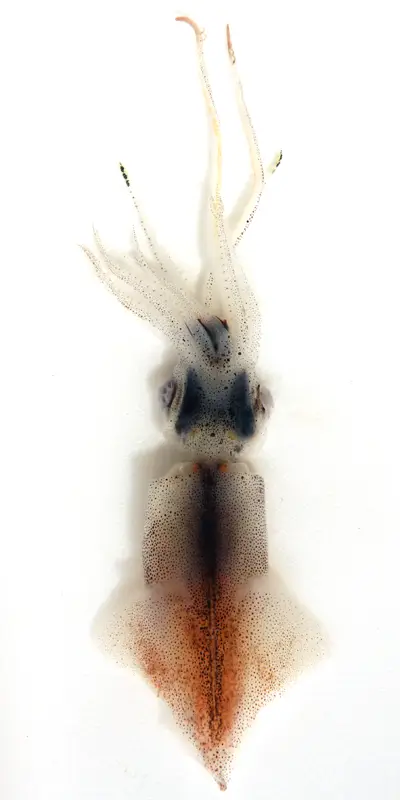
Firefly squid
Watasenia scintillans (Firefly squid · ホタルイカ)
💡 Everyday Comparisons for Size, Mass & Speed
- 💡 Its annual spring gathering along the coast of Toyama Bay, creating a spectacular display of blue light, is famous as a springtime sight on the west coast of Japan (Scientific Reports).
- 💡 Its maximum mantle length of 6.7 cm is shorter than the long side of a credit card (8.56 cm) (Comparison).
Reference standards: coach bus ~12 m, mid-size car ~4.9 m, compact car ~1 t, basketball hoop 3.05 m, credit card 8.56 cm.
📖 1. Overview
The firefly squid is a small squid that gathers along the coast of Toyama Bay in Japan every spring to spawn, glowing with blue light.
🦴 2. Anatomy & Morphology
Its body length is 6–7 cm, and it has three types of photophores (light-producing organs). The 3 large photophores at the tips of the fourth arms emit the brightest blue light, 5 small photophores line up below each eye, and hundreds of tiny photophores are scattered across the ventral skin.
🔍 3. Ecology & Behavior
In surveys in Toyama Bay, juveniles ate copepods, while adults ate copepods, krill, amphipods, fish, and squid. In spring, they come close to shore to spawn.
🇰🇷 4. Connection to Korea
It is listed on the National List of Species of Korea under the Korean name Mae-ojingeo (Korean name).
📚 Sources & References
- • IUCN Red List LC (2014) — https://www.iucnredlist.org/species/163146/977074
- • IUCN Red List category LC — latest assessment at iucnredlist.org
- • marinespecies.org — aphia.php
- • iucnredlist.org — 977074
- • 국가생물종목록(국립생물자원관) ktsn 120000203838 — https://species.nibr.go.kr/home/mainHome.do?cont_link=009&subMenu=009002&contCd=009002&ktsn=120000203838
- • wikidata.org — Q303718
- • commons.wikimedia.org — File:Watasenia scintillans.jpg
- • agris.fao.org — 64723696e17b74d2224ec18c
- • nature.com — srep27638
- • sealifebase.se — Watasenia-scintillans.html
Recorded dimensions are widely cited representative estimates from public literature and may vary by study or specimen.