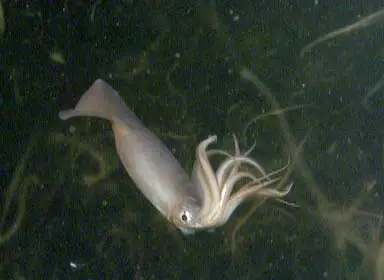
 📸 Photo
Photo: Image courtesy of NOAA/MBARI 2006 · Public domain · Wikimedia Commons Source
Humboldt squid
Dosidicus gigas (Humboldt squid · アメリカオオアカイカ)
💡 Everyday Comparisons for Size, Mass & Speed
- 💡 Its maximum weight of 50 kg equals two and a half 20 kg bags of rice (Comparison).
- 💡 A mantle length of 2 m is similar to the height of a doorway (about 2 m) (Comparison).
- 💡 The fishery for this squid is the largest cephalopod fishery in the world, and it is used as food (ADW).
Reference standards: coach bus ~12 m, mid-size car ~4.9 m, compact car ~1 t, basketball hoop 3.05 m, credit card 8.56 cm.
Site-computed relative index from recorded values; not a formal scientific metric.
📖 1. Overview
The Humboldt squid is a large schooling squid in the eastern Pacific, nicknamed the 'red devil' because its body turns bright red when caught and brought to the surface.
🦴 2. Anatomy & Morphology
It has a long, thick mantle, 100–200 hooked suckers on each tentacle, and a powerful beak for tearing prey. Its eyes and chromatophores are well developed, allowing it to change color and flash signals.
🔍 3. Ecology & Behavior
It rises toward the surface at night to feed mainly on lanternfish and descends to deep water during the day. It reproduces only once in its lifetime, and juveniles swim in schools of 20–40 individuals.
🇰🇷 4. Connection to Korea
No direct record connecting this species to Korea has been found.
📚 Sources & References
- • IUCN Red List DD (2014) — https://www.iucnredlist.org/species/162959/958088
- • IUCN Red List category DD — latest assessment at iucnredlist.org
- • marinespecies.org — aphia.php
- • iucnredlist.org — 958088
- • wikidata.org — Q925444
- • commons.wikimedia.org — File:Dosidicus gigas.jpg
- • animaldiversity.org — Dosidicus gigas
- • sealifebase.se — Dosidicus-gigas.html
- • Silhouette: PhyloPic — Margot Michaud · CC0 1.0 (Related taxon silhouette — Todarodes pacificus)
Recorded dimensions are widely cited representative estimates from public literature and may vary by study or specimen.