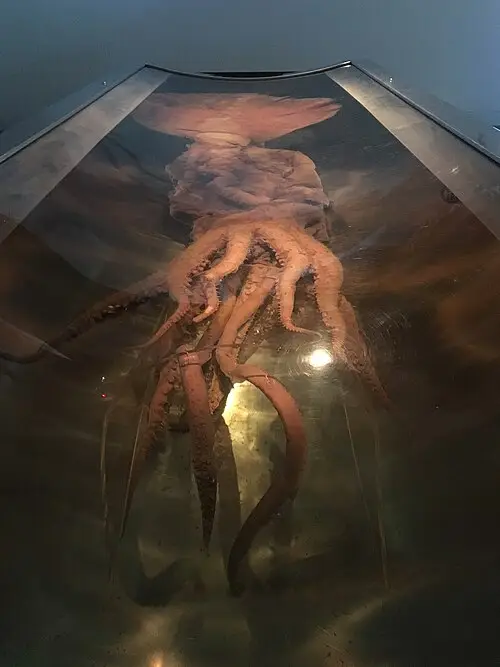
 📸 Photo
Photo: Scotted400 · CC BY-SA 4.0 · Wikimedia Commons Source
Colossal squid
Mesonychoteuthis hamiltoni (Colossal squid · ダイオウホウズキイカ)
💡 Everyday Comparisons for Size, Mass & Speed
- 💡 Its maximum total length of 4.2 m is almost the same length as a passenger car (about 4.5 m) (Comparison).
- 💡 Its maximum weight of 495 kg is close to 25 bags of 20 kg rice (Comparison).
- 💡 ADW estimates that a single 5 kg Patagonian toothfish provides enough energy for a 500 kg squid to survive for about 200 days.
Reference standards: coach bus ~12 m, mid-size car ~4.9 m, compact car ~1 t, basketball hoop 3.05 m, credit card 8.56 cm.
Site-computed relative index from recorded values; not a formal scientific metric.
📖 1. Overview
The colossal squid is a giant squid living in the deep waters around the Southern Ocean and is considered the largest known invertebrate.
🦴 2. Anatomy & Morphology
Its eyes reach up to 30 cm in diameter, possibly the largest in the animal kingdom, and it has the largest beak of any squid along with 25 rotating hooks arranged in two rows at the tips of its tentacles.
🔍 3. Ecology & Behavior
It appears to be an ambush predator that eats large fish such as large toothfish as well as other squids. Because of its huge body, it is thought to need little food and live at a slow pace. Adult beaks have been found inside sperm whale stomachs, showing that adults reach great depths.
🇰🇷 4. Connection to Korea
No direct record connecting this species to Korea has been found.
📚 Sources & References
- • IUCN Red List LC (2014) — https://www.iucnredlist.org/species/163170/980001
- • IUCN Red List category LC — latest assessment at iucnredlist.org
- • marinespecies.org — aphia.php
- • iucnredlist.org — 980001
- • wikidata.org — Q378330
- • commons.wikimedia.org — File:Colossal squid in Te Papa.jpg
- • sealifebase.se — Mesonychoteuthis-hamiltoni.html
- • animaldiversity.org — Mesonychoteuthis hamiltoni
- • Silhouette: PhyloPic — Margot Michaud · CC0 1.0 (Related taxon silhouette — Heliococrachia pfefferi)
Recorded dimensions are widely cited representative estimates from public literature and may vary by study or specimen.