 📸 Photo
Photo: self · CC BY-SA 3.0 · Wikimedia Commons Source
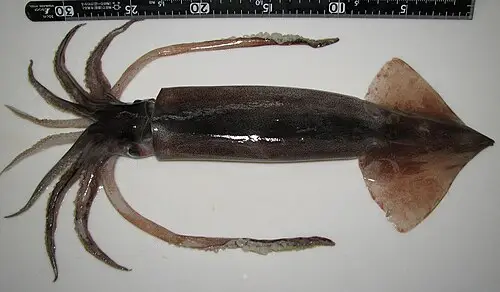
Japanese flying squid
Todarodes pacificus (Japanese flying squid · スルメイカ)
💡 Everyday Comparisons for Size, Mass & Speed
- 💡 Its common length of 30 cm is the same as a 30 cm ruler (Comparison).
- 💡 Its maximum weight of 500 g is similar to the weight of a 500 mL bottle of water (Comparison).
- 💡 The squid most commonly eaten in Korea all belong to this species, and it is caught with jigging machines, bottom trawls, purse seines, and set nets (National List of Species of Korea; SeaLifeBase).
Reference standards: coach bus ~12 m, mid-size car ~4.9 m, compact car ~1 t, basketball hoop 3.05 m, credit card 8.56 cm.
Site-computed relative index from recorded values; not a formal scientific metric.
📖 1. Overview
The Japanese flying squid is the squid commonly called simply 'squid' in Korea and is the most widely eaten squid species there. In the past it was caught mainly along the East Sea coast, but today it appears throughout Korean waters.
🦴 2. Anatomy & Morphology
Its length is usually around 30 cm. Its hectocotylized arm is long and its copulatory organ is well developed.
🔍 3. Ecology & Behavior
Juveniles feed on zooplankton, while growing individuals eat small fish, crustaceans, and mollusks. It spawns across January–March, June–August, and September–November, carrying about 500,000 eggs.
🇰🇷 4. Connection to Korea
It is listed on the National List of Species of Korea under the name Sal-ojingeo (Korean name) and lives in the East Sea, South Sea, Yellow Sea, and Jeju Island. Among squid families in Korea, it is the only species in the family Ommastrephidae.
📚 Sources & References
- • IUCN Red List LC (2014) — https://www.iucnredlist.org/species/176085/1428473
- • IUCN Red List category LC — latest assessment at iucnredlist.org
- • marinespecies.org — aphia.php
- • iucnredlist.org — 1428473
- • 국가생물종목록(국립생물자원관) ktsn 120000044171 — https://species.nibr.go.kr/home/mainHome.do?cont_link=009&subMenu=009002&contCd=009002&ktsn=120000044171
- • wikidata.org — Q780352
- • commons.wikimedia.org — File:Todarodes pacificus ruler.jpg
- • sealifebase.se — Todarodes-pacificus.html
- • species.nibr.go.kr — mainHome.do
- • Silhouette: PhyloPic — Margot Michaud · CC0 1.0
Recorded dimensions are widely cited representative estimates from public literature and may vary by study or specimen.