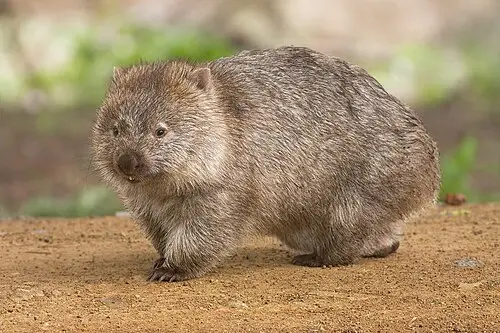
 📸 Photo
Photo: JJ Harrison ( jjharrison89@facebook.com ) · CC BY-SA 3.0 · Wikimedia Commons Source
Common Wombat
Vombatus ursinus (Common Wombat · ウォンバット)
💡 Everyday Comparisons for Size, Mass & Speed
- 💡 Its maximum weight of 35 kg is just under two 20 kg bags of rice, and its maximum length of 1.1 m is similar to the height of a lower-grade elementary school child (Comparison).
- 💡 In the past it was hunted for its pelt, but today it is protected and hunting is illegal.
Reference standards: coach bus ~12 m, mid-size car ~4.9 m, compact car ~1 t, basketball hoop 3.05 m, credit card 8.56 cm.
Site-computed relative index from recorded values; not a formal scientific metric.
📖 1. Overview
The Common Wombat is a stocky, grass-eating animal that digs underground burrows in temperate forests and scrubby hills of southeastern Australia.
🦴 2. Anatomy & Morphology
It has a squat build with a broad, rounded head, short tail and legs, and small eyes and ears. It has rootless incisors that grow continuously, thick coarse fur, and strong claws on its legs suited for digging burrows.
🔍 3. Ecology & Behavior
It eats grasses, sedges, moss, and sometimes shrubs and roots. Emerging from its burrow at dusk to graze, it repeatedly visits the same spots to create short 'marsupial lawns.' It usually gives birth to a single young every 2 years.
🇰🇷 4. Connection to Korea
No direct record connecting this species to Korea has been found.
📚 Sources & References
- • IUCN Red List LC (2025) — https://www.iucnredlist.org/species/40556/258654868
- • IUCN Red List category LC — latest assessment at iucnredlist.org
- • mammaldiversity.org — 1000407
- • iucnredlist.org — 258654868
- • wikidata.org — Q752436
- • commons.wikimedia.org — File:Vombatus ursinus -Maria Island National Park.jpg
- • animaldiversity.org — Vombatus ursinus
- • Silhouette: PhyloPic — Sarah Werning · CC BY 3.0
Recorded dimensions are widely cited representative estimates from public literature and may vary by study or specimen.