 📸 Photo
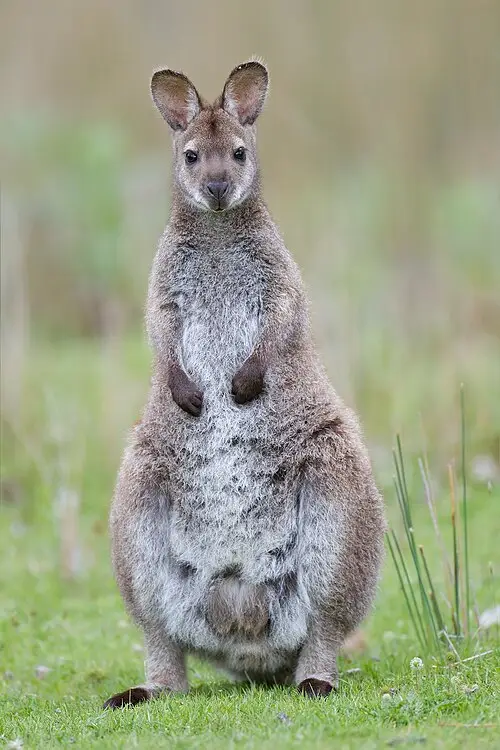
Photo: Noodle snacks ( https://www.jjharrison.com.au/)Bennett's Wallaby) · CC BY-SA 3.0 · Wikimedia Commons Source
Red-necked Wallaby
Notamacropus rufogriseus (Red-necked Wallaby · アカクビワラビー)
💡 Everyday Comparisons for Size, Mass & Speed
- 💡 A maximum weight of 18.6 kg is slightly lighter than a 20 kg bag of rice, and a maximum head-body length of 1.05 m is similar to the height of a grade 1–2 elementary school child (Comparison).
- 💡 Pelts of the Tasmanian subspecies are exported from Queensland and Tasmania, while the wallabies sometimes damage crops or trample young trees in forestry plantations.
Reference standards: coach bus ~12 m, mid-size car ~4.9 m, compact car ~1 t, basketball hoop 3.05 m, credit card 8.56 cm.
Site-computed relative index from recorded values; not a formal scientific metric.
📖 1. Overview
The Red-necked Wallaby is a medium-sized wallaby living in eucalyptus forests and coastal heathlands of Australia, named for the reddish fur on its nape and shoulders.
🦴 2. Anatomy & Morphology
Its body is yellowish-gray with a white chest and belly, and its tail is gray above and white below. Males are larger than females, and its ears are relatively long compared with other kangaroos and wallabies.
🔍 3. Ecology & Behavior
It grazes mainly on grasses and herbs, obtaining water from juicy roots during dry periods. Females give birth to a single young at a time, which spends about 280 days in the pouch.
🇰🇷 4. Connection to Korea
No direct record connecting this species to Korea has been found.
📚 Sources & References
- • IUCN Red List LC (2016) — https://www.iucnredlist.org/species/40566/21953329
- • IUCN Red List category LC — latest assessment at iucnredlist.org
- • mammaldiversity.org — 1000285
- • iucnredlist.org — 21953329
- • wikidata.org — Q109262323
- • commons.wikimedia.org — File:Macropus rufogriseus rufogriseus Bruny.jpg
- • animaldiversity.org — Macropus rufogriseus
- • Silhouette: PhyloPic — Kawinwit Kittipalawattanapol · CC0 1.0
Recorded dimensions are widely cited representative estimates from public literature and may vary by study or specimen.