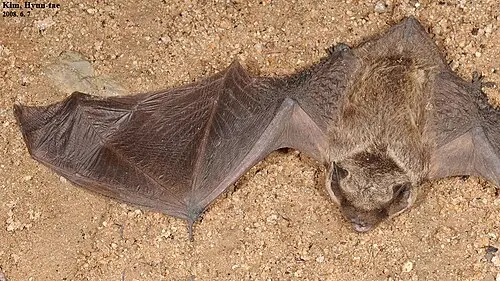
 📸 Photo
Photo: Kim, Hyun-tae (pintail) · CC BY 4.0 · Wikimedia Commons Source
Asian Particolored Bat
Vespertilio sinensis (Asian Particolored Bat · ヒナコウモリ)
💡 Everyday Comparisons for Size, Mass & Speed
- 💡 The 6–6.4 g of insects it eats per day is slightly heavier than one Korean 100-won coin (about 5.4 g) (Comparison).
- 💡 Because it roosts in groups under roof tiles of old houses and in buildings, it can be encountered near cities.
- 💡 Its wingspan of about 25 cm is about 4 cm longer than the short side of a sheet of A4 paper (21 cm) (Comparison).
Reference standards: coach bus ~12 m, mid-size car ~4.9 m, compact car ~1 t, basketball hoop 3.05 m, credit card 8.56 cm.
📖 1. Overview
The Asian Particolored Bat lives in East Asia; because the cream-colored tips of its fur look like frost, it is also called "dongyang-eollukbakjwi" (a Korean name meaning Oriental particolored bat).
🦴 2. Anatomy & Morphology
Its back fur is blackish brown with cream-colored tips, its snout is broad, and its ear tips form rounded triangles. Its forearm measures 46–50 mm and its tragus is long at about 7 mm.
🔍 3. Ecology & Behavior
It catches flying insects from evening into the night, eating 6–6.4 g per day, or 33–36% of its body weight. Females gather in colonies of dozens or more and give birth in June–July (months 6–7) to 1–3 young, usually 2.
🇰🇷 4. Connection to Korea
The National List of Species of Korea records its domestic distribution as nationwide (excluding islands). It has been observed in Seoul, Uijeongbu in Gyeonggi-do, and Busan, and commonly lives in crevices under roof tiles of old houses or in artificial structures.
📚 Sources & References
- • IUCN Red List LC (2019) — https://www.iucnredlist.org/species/22949/22071812
- • IUCN Red List category LC — latest assessment at iucnredlist.org
- • mammaldiversity.org — 1005793
- • iucnredlist.org — 22071812
- • 국가생물종목록(국립생물자원관) ktsn 120000053287 — https://species.nibr.go.kr/home/mainHome.do?cont_link=009&subMenu=009002&contCd=009002&ktsn=120000053287
- • wikidata.org — Q1833588
- • commons.wikimedia.org — File:Vespertilio sinensis turpis from iNaturalist photo 2798
- • species.nibr.go.kr — mainHome.do
- • Silhouette: PhyloPic — Johann Christian Daniel von Schreber · Public Domain Mark 1.0 (Congeneric silhouette — Vespertilio murinus)
Recorded dimensions are widely cited representative estimates from public literature and may vary by study or specimen.