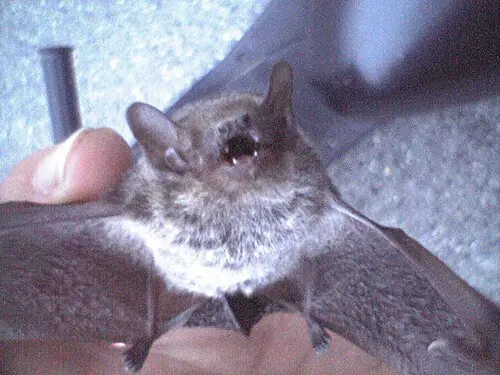
 📸 Photo
Photo: Original uploader was OAS at ja.wikipedia · CC BY-SA 3.0 · Wikimedia Commons Source
Japanese Pipistrelle
Alionoctula abramus (Japanese Pipistrelle · 動物)
Not Evaluated (NE) on the IUCN Red List yet.
💡 Everyday Comparisons for Size, Mass & Speed
- 💡 Seen catching insects under city streetlights, it is the bat people most easily encounter.
- 💡 Its weight of 3.8–5.8 g is similar to a single sheet of A4 paper (about 5 g) (Comparison).
Reference standards: coach bus ~12 m, mid-size car ~4.9 m, compact car ~1 t, basketball hoop 3.05 m, credit card 8.56 cm.
Site-computed relative index from recorded values; not a formal scientific metric.
📖 1. Overview
The Japanese pipistrelle is a small bat that roosts in crevices of human houses and buildings, ranging across the Russian Far East, Korea, Japan, China, Taiwan, and northern Southeast Asia.
🦴 2. Anatomy & Morphology
Its back is grayish brown and its belly is paler grayish brown, with thin, round-tipped ears. The tail membrane extends nearly to the tip of the tail.
🔍 3. Ecology & Behavior
It emerges 10–30 minutes after sunset to catch various insects around streetlights and similar places. It mates in October and stores sperm until fertilizing eggs after waking from hibernation; after about 70 days of gestation it gives birth to 2–4 young, and hibernates from late October to March.
🇰🇷 4. Connection to Korea
It is listed as Jipbakjwi (Pipistrellus abramus, Korean name) in the National List of Species of Korea (National Institute of Biological Resources (NIBR)) and has no national-level legally protected status. Once common, it has declined with the spread of concrete buildings, and Jeollanam-do and Gyeonggi-do have designated it as a protected species.
📚 Sources & References
- • IUCN Red List: not evaluated (NE) — cross-checked with the Wikidata conservation-status entry
- • mammaldiversity.org — 1005609
- • 국가생물종목록(국립생물자원관) ktsn 120000053282 — https://species.nibr.go.kr/home/mainHome.do?cont_link=009&subMenu=009002&contCd=009002&ktsn=120000053282
- • wikidata.org — Q729
- • tb.plazi.org — 4C3D87E8FFE86A50FA859A8319A5BF80
- • tb.plazi.org — 03A0BE3B6430FF84FF4FF97DFDEA56E2
- • bio.bris.ac.uk — pipistrellusabramus.htm
- • Silhouette: PhyloPic — Andy Wilson · CC0 1.0 (Related taxon silhouette — Nyctalus noctula)
Recorded dimensions are widely cited representative estimates from public literature and may vary by study or specimen.