 📸 Photo
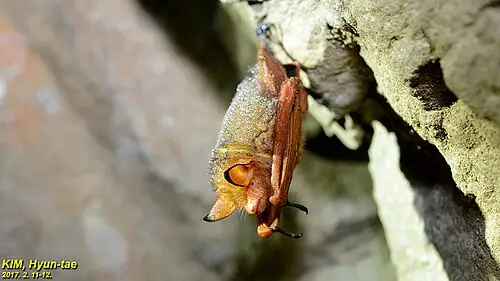
Photo: (c) Kim, Hyun-tae, some rights reserved (CC BY) · CC BY 4.0 · Wikimedia Commons Source
Reddish-black Myotis
Myotis rufoniger (Reddish-black Myotis · Reddish-black Myotis)
🇰🇷 Class I endangered wildlife (Korea) · Natural Monument (Korea) «Reddish-black Myotis (Orange-whiskered Bat)»
💡 Everyday Comparisons for Size, Mass & Speed
- 💡 A maximum weight of 15 g is about the weight of three sheets of A4 paper (about 5 g per sheet) (Comparison).
- 💡 Because it chooses undisturbed caves and abandoned mines for hibernation, refraining from entering caves or mine entrances in winter is an everyday way to help protect this bat.
Reference standards: coach bus ~12 m, mid-size car ~4.9 m, compact car ~1 t, basketball hoop 3.05 m, credit card 8.56 cm.
Site-computed relative index from recorded values; not a formal scientific metric.
📖 1. Overview
The Reddish-black Myotis is a medium-sized bat with vivid orange fur across its body, living in mountain forests of Korea, Tsushima in Japan, China, Taiwan, Vietnam, and Laos.
🦴 2. Anatomy & Morphology
Its fur is long, soft, and deep orange, and its black wings have orange areas along the bones and close to the body. The nose tip, thumbs, and feet are black.
🔍 3. Ecology & Behavior
It feeds mainly on moths along with small amounts of ants and spiders. It hibernates in warm, humid caves and abandoned mines with little human disturbance from late October to late May, and in Korea usually gives birth to a single young from late June to early July.
🇰🇷 4. Connection to Korea
It is listed as Class I endangered wildlife (Korea) in the National List of Species of Korea (National Institute of Biological Resources (NIBR)) and was designated a Natural Monument (Korea) by the Korea Heritage Service on March 17, 2005. In Hampyeong, Jeollanam-do, 878 ha of forest has been designated as a conservation area for this species.
📚 Sources & References
- • IUCN Red List LC (2020) — https://www.iucnredlist.org/species/85735909/85735913
- • 멸종위기 야생생물 Ⅰ급 · 천연기념물 «붉은박쥐(오렌지윗수염박쥐)» — 국가생물종목록(국립생물자원관) ktsn 120000209294 — https://species.nibr.go.kr/home/mainHome.do?cont_link=009&subMenu=009002&contCd=009002&ktsn=120000209294
- • IUCN Red List category LC — latest assessment at iucnredlist.org
- • Korean protection status: Class I endangered wildlife (Korea) · Natural Monument (Korea) «Reddish-black Myotis (Orange-whiskered Bat)»
- • mammaldiversity.org — 1005465
- • iucnredlist.org — 85735913
- • 국가생물종목록(국립생물자원관) ktsn 120000209294 — https://species.nibr.go.kr/home/mainHome.do?cont_link=009&subMenu=009002&contCd=009002&ktsn=120000209294
- • heritage.go.kr — culSelectDetail.do
- • wikidata.org — Q20721930
- • commons.wikimedia.org — File:Black-winged Myotis imported from iNaturalist photo 626
- • tb.plazi.org — 4C3D87E8FF466AFAFA8E9A951D07B3C5
- • encykorea.aks.ac.kr — E0075045
- • heritage.go.kr — culSelectDetail.do
- • tb.plazi.org — 03A0BE3B6422FF96FF4FFC02FE7E509B
- • Silhouette: PhyloPic — Archibald Thorburn · Public Domain Mark 1.0 (Congeneric silhouette — Myotis daubentonii)
Recorded dimensions are widely cited representative estimates from public literature and may vary by study or specimen.