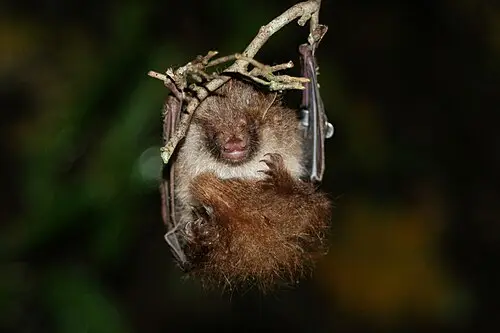
 📸 Photo
Photo: Pxc06142 · CC BY-SA 4.0 · Wikimedia Commons Source
Ussuri Tube-nosed Bat
Murina ussuriensis (Ussuri Tube-nosed Bat · コテングコウモリ)
🇰🇷 Class I endangered wildlife (Korea)
💡 Everyday Comparisons for Size, Mass & Speed
- 💡 A wingspan of 19–22 cm is similar to the short side of an A4 sheet of paper (21 cm) (Comparison).
- 💡 A weight of 5–6 g is lighter than a single Korean 500-won coin (about 7.7 g) (Comparison).
Reference standards: coach bus ~12 m, mid-size car ~4.9 m, compact car ~1 t, basketball hoop 3.05 m, credit card 8.56 cm.
Site-computed relative index from recorded values; not a formal scientific metric.
📖 1. Overview
The Ussuri Tube-nosed Bat is a small bat around 5 cm in body length with tube-like protruding nostrils. It lives in temperate forests of the Russian Primorye region, northeastern China, the Korean Peninsula, and Japan.
🦴 2. Anatomy & Morphology
Its fur is short and dense, golden-reddish to grayish-brown on the back and pale grayish-white on the belly. Its nearly hairless nostrils protrude in long tubes, and the entire tail membrane is covered with hair.
🔍 3. Ecology & Behavior
It catches flying insects in forests after sunset and has even been observed catching dragonflies. In Japan, females give birth to one or two young between late May and late July, and individuals usually hibernate alone.
🇰🇷 4. Connection to Korea
It is listed as Class I endangered wildlife (Korea) in the National List of Species of Korea (National Institute of Biological Resources (NIBR)). Records from the Zoological Museum in Russia also include North Korea in its range.
📚 Sources & References
- • IUCN Red List LC (2019) — https://www.iucnredlist.org/species/84562332/22095832
- • 멸종위기 야생생물 Ⅰ급 — 국가생물종목록(국립생물자원관) ktsn 120000053271 — https://species.nibr.go.kr/home/mainHome.do?cont_link=009&subMenu=009002&contCd=009002&ktsn=120000053271
- • IUCN Red List category LC — latest assessment at iucnredlist.org
- • Korean protection status: Class I endangered wildlife (Korea)
- • mammaldiversity.org — 1005355
- • iucnredlist.org — 22095832
- • 국가생물종목록(국립생물자원관) ktsn 120000053271 — https://species.nibr.go.kr/home/mainHome.do?cont_link=009&subMenu=009002&contCd=009002&ktsn=120000053271
- • wikidata.org — Q2745348
- • commons.wikimedia.org — File:Murina ussuriensis.jpg
- • tb.plazi.org — 4C3D87E8FF6C6ADCFA4497B91A94B910
- • zmmu.msu.ru — muruss e.htm
- • Silhouette: PhyloPic — Andy Wilson · CC0 1.0 (Related taxon silhouette — Nyctalus noctula)
Recorded dimensions are widely cited representative estimates from public literature and may vary by study or specimen.