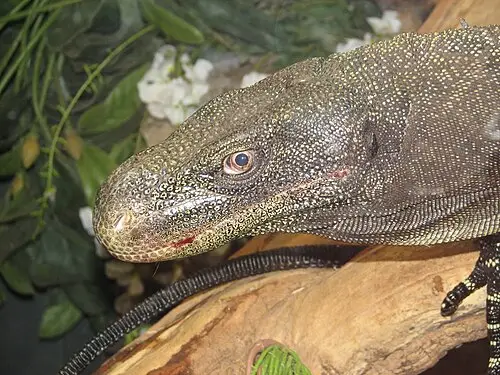
 📸 Photo
Photo: Ltshears · CC BY 3.0 · Wikimedia Commons Source
Crocodile Monitor
Varanus salvadorii (Crocodile Monitor · ハナブトオオトカゲ)
💡 Everyday Comparisons for Size, Mass & Speed
- 💡 An average length of 3 m is about 2/3 the length of a passenger car (about 4.5 m), and an average weight of 20 kg is equal to a 20 kg bag of rice (Comparison).
- 💡 Indigenous peoples of New Guinea use its meat and skin, with the skin used for ceremonial drum heads. Rather than being hunted deliberately, it is often caught in traps set for other animals (University of Michigan Museum of Zoology ADW).
Reference standards: coach bus ~12 m, mid-size car ~4.9 m, compact car ~1 t, basketball hoop 3.05 m, credit card 8.56 cm.
Site-computed relative index from recorded values; not a formal scientific metric.
📖 1. Overview
The Crocodile Monitor is the largest monitor lizard in New Guinea, moving between trees and the ground in coastal forests.
🦴 2. Anatomy & Morphology
Its tail is about twice as long as its torso, and its black body is speckled with yellow, white, or green spots. It has a rounded snout, a long forked tongue, very long straight teeth, and strong claws.
🔍 3. Ecology & Behavior
It eats birds such as parrots and Maleos along with their eggs, as well as rodents, reptiles, amphibians, insects, and carrion, swallowing prey whole. It basks during the day and is agile enough to leap from branch to branch.
🇰🇷 4. Connection to Korea
No direct record connecting this species to Korea has been found.
📚 Sources & References
- • IUCN Red List LC (2016) — https://www.iucnredlist.org/species/42485775/42485784
- • IUCN Red List category LC — latest assessment at iucnredlist.org
- • catalogueoflife.org — 7FG6S
- • iucnredlist.org — 42485784
- • wikidata.org — Q940883
- • commons.wikimedia.org — File:Crocodile Monitor.jpg
- • animaldiversity.org — Varanus salvadorii
- • Silhouette: PhyloPic — Christina Zdenek · CC BY 4.0 (Congeneric silhouette — Varanus storri storri)
Recorded dimensions are widely cited representative estimates from public literature and may vary by study or specimen.