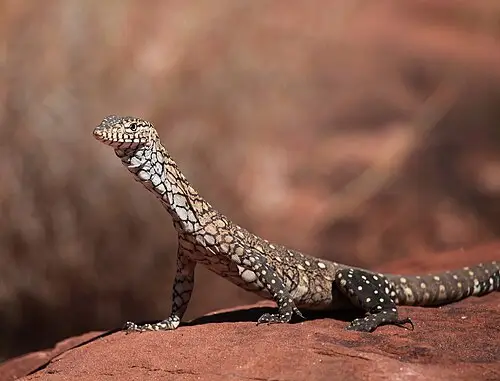
 📸 Photo
Photo: Christopher Watson ( http://www.comebirdwatching.blogspot.com/ ) · CC BY-SA 3.0 · Wikimedia Commons Source
Perentie
Varanus giganteus (Perentie · ペレンティーオオトカゲ)
💡 Everyday Comparisons for Size, Mass & Speed
- 💡 A length of about 2.4 m is longer than the height of a doorway (about 2 m), and a weight of about 12 kg is slightly heavier than a 10 kg bag of rice. A speed of 40 km/h is about twice as fast as a brisk bicycle ride (about 20 km/h) (Comparison).
- 💡 The pattern of this lizard is used in Indigenous Australian (Aboriginal) art (Los Angeles Zoo).
Reference standards: coach bus ~12 m, mid-size car ~4.9 m, compact car ~1 t, basketball hoop 3.05 m, credit card 8.56 cm.
Site-computed relative index from recorded values; not a formal scientific metric.
📖 1. Overview
The Perentie is a large monitor lizard living in arid inland Australia, closely related to the Komodo Dragon.
🦴 2. Anatomy & Morphology
Its muscular, laterally flattened tail serves as a defensive weapon and does not regenerate once lost. Its teeth are long, sharp, serrated, and curved backward so prey cannot escape.
🔍 3. Ecology & Behavior
Active by day, it tracks prey by scent with its tongue and roams a large home range. Juveniles eat lizards, insects, and small mammals, while adults eat a wide range of prey including highly venomous snakes as well as carrion.
🇰🇷 4. Connection to Korea
No direct record connecting this species to Korea has been found.
📚 Sources & References
- • IUCN Red List LC (2018) — https://www.iucnredlist.org/species/83777786/101752310
- • IUCN Red List category LC — latest assessment at iucnredlist.org
- • catalogueoflife.org — 7FG7D
- • iucnredlist.org — 101752310
- • wikidata.org — Q932293
- • commons.wikimedia.org — File:Varanus giganteus 14 - Christopher Watson.jpg
- • lazoo.org — perentie
- • Silhouette: PhyloPic — Christina Zdenek · CC BY 4.0 (Congeneric silhouette — Varanus storri storri)
Recorded dimensions are widely cited representative estimates from public literature and may vary by study or specimen.