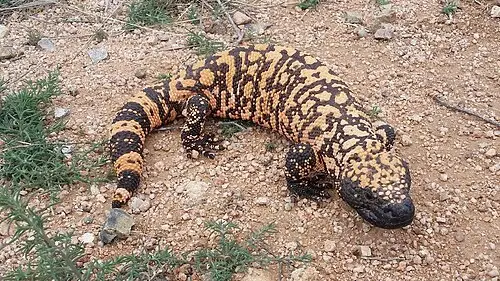
 📸 Photo
Photo: Josh Olander · CC BY 4.0 · Wikimedia Commons Source
Gila Monster
Heloderma suspectum (Gila Monster · アメリカドクトカゲ)
💡 Everyday Comparisons for Size, Mass & Speed
- 💡 Its maximum total length of 56 cm is nearly twice the long side of an A4 sheet (29.7 cm) (Comparison).
- 💡 In the U.S. states where this species lives, capturing or keeping it is illegal (University of Michigan Museum of Zoology ADW). Its name comes from the Gila River, where these lizards are common (Smithsonian's National Zoo).
Reference standards: coach bus ~12 m, mid-size car ~4.9 m, compact car ~1 t, basketball hoop 3.05 m, credit card 8.56 cm.
📖 1. Overview
The Gila Monster is a heavy, stout venomous lizard living in deserts of the southwestern United States, and is one of the very few venomous lizards.
🦴 2. Anatomy & Morphology
It has a thick head and body, a short, plump tail, and bead-like scales patterned in yellow, pink (or orange), and black. Instead of hollow fangs, it chews venom in through large grooved teeth in its lower jaw.
🔍 3. Ecology & Behavior
Using its sense of smell, it finds and eats young rabbits, mice, squirrels, birds, lizards, and the eggs of various animals. Adults can eat up to 35% of their body weight in a single meal, well suited to places where prey is scarce, and their venom is used mainly for defense.
🇰🇷 4. Connection to Korea
No direct record connecting this species to Korea has been found.
📚 Sources & References
- • IUCN Red List NT (2007) — https://www.iucnredlist.org/species/9865/13022716
- • IUCN Red List category NT — latest assessment at iucnredlist.org
- • catalogueoflife.org — 3KGXZ
- • iucnredlist.org — 13022716
- • wikidata.org — Q207058
- • commons.wikimedia.org — File:AZ Gila Monster 01.jpg
- • nationalzoo.si.edu — gila-monster
- • animaldiversity.org — Heloderma suspectum
- • Silhouette: PhyloPic — Nicolas Mongiardino Koch · CC0 1.0
Recorded dimensions are widely cited representative estimates from public literature and may vary by study or specimen.