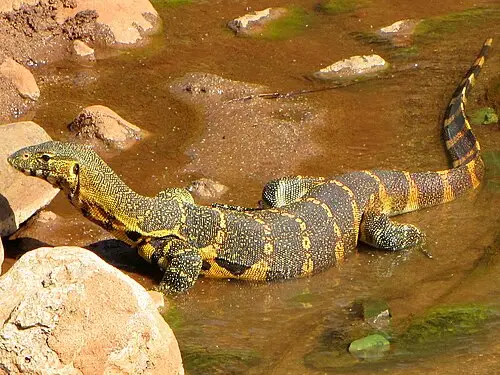
 📸 Photo
Photo: D. Gordon E. Robertson · CC BY-SA 3.0 · Wikimedia Commons Source
Nile Monitor
Varanus niloticus (Nile Monitor · ナイルオオトカゲ)
💡 Everyday Comparisons for Size, Mass & Speed
- 💡 A length of 2.4 m is longer than the height of a doorway (about 2 m) (Comparison).
- 💡 In Africa it is one of the most heavily harvested tetrapods for its meat and skin, and it also eats crocodile eggs, helping regulate crocodile numbers. Some people keep it as a pet, but because it is large and aggressive it is unsuitable for beginners (University of Michigan Museum of Zoology ADW).
Reference standards: coach bus ~12 m, mid-size car ~4.9 m, compact car ~1 t, basketball hoop 3.05 m, credit card 8.56 cm.
📖 1. Overview
The Nile Monitor is one of the largest lizards in Africa, skilled at both swimming and climbing trees near watersides.
🦴 2. Anatomy & Morphology
It has a sturdy build and climbs trees well with its sharp claws and strong legs. Its deep, stout skull and blunt rear teeth are well suited for crushing hard shells such as those of bivalves.
🔍 3. Ecology & Behavior
It stalks and pounces on a wide variety of prey including frogs, toads, rodents, fish, lizards, birds and their eggs, crabs, and spiders. It breeds once a year in months 6–10, and flees or dives into water when threatened.
🇰🇷 4. Connection to Korea
No direct record connecting this species to Korea has been found.
📚 Sources & References
- • IUCN Red List LC (2021) — https://www.iucnredlist.org/species/198539/2531945
- • IUCN Red List category LC — latest assessment at iucnredlist.org
- • catalogueoflife.org — 7FG7Z
- • iucnredlist.org — 2531945
- • wikidata.org — Q737896
- • commons.wikimedia.org — File:Nile Monitor, Lake Manyara.jpg
- • animaldiversity.org — Varanus niloticus
- • Silhouette: PhyloPic — Christina Zdenek · CC BY 4.0 (Congeneric silhouette — Varanus storri storri)
Recorded dimensions are widely cited representative estimates from public literature and may vary by study or specimen.