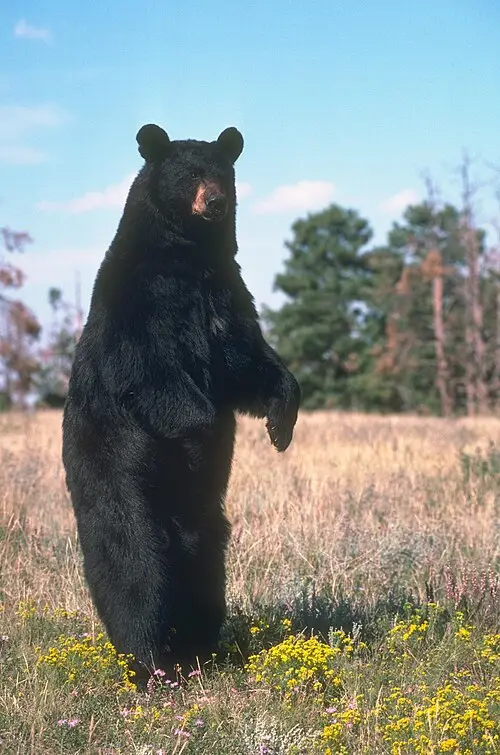
 📸 Photo
Photo: California Department of Fish and Wildlife from Sacramento, CA, USA · CC BY 2.0 · Wikimedia Commons Source
American Black Bear
Ursus americanus (American Black Bear · アメリカグマ)
💡 Everyday Comparisons for Size, Mass & Speed
- 💡 A male's maximum weight of 409 kg equals 20 bags of 20 kg rice, and its length of about 2 m is similar to the length of a bed (Comparison).
- 💡 About 30,000 individuals are hunted each year in North America for fur, meat, and fat. Meanwhile, research on how its body works during long winter sleep is offering new clues for treating kidney failure, gallstones, and severe burns (ADW).
Reference standards: coach bus ~12 m, mid-size car ~4.9 m, compact car ~1 t, basketball hoop 3.05 m, credit card 8.56 cm.
Site-computed relative index from recorded values; not a formal scientific metric.
📖 1. Overview
The American Black Bear lives in North American forests and feeds mostly on plants. It prefers hard-to-reach places with thick brush and abundant food.
🦴 2. Anatomy & Morphology
In the east it is mostly black with a pale snout and sometimes a white patch on the chest. In the west brown, cinnamon, and blonde coats are common, while creamy white or bluish-gray individuals occur along the coasts of British Columbia and Alaska.
🔍 3. Ecology & Behavior
It eats grasses in spring, fruits in summer, and nuts in autumn. Its animal food consists mostly of insects and carrion. Gestation lasts about 220 days, but because of delayed implantation, cubs are born mainly in January and February (months 1–2).
🇰🇷 4. Connection to Korea
No direct record connecting this species to Korea has been found.
📚 Sources & References
- • IUCN Red List LC (2016) — https://www.iucnredlist.org/species/41687/114251609
- • IUCN Red List category LC — latest assessment at iucnredlist.org
- • mammaldiversity.org — 1005934
- • iucnredlist.org — 114251609
- • wikidata.org — Q122783
- • commons.wikimedia.org — File:American black bear (19647087094).jpg
- • animaldiversity.org — Ursus americanus
- • Silhouette: PhyloPic — author not recorded · CC0 1.0
Recorded dimensions are widely cited representative estimates from public literature and may vary by study or specimen.