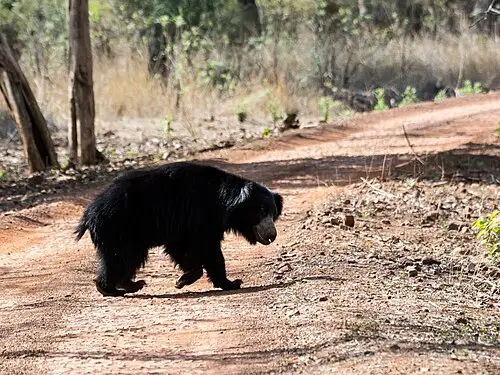
 📸 Photo
Photo: Saumitra Newalkar · CC BY-SA 4.0 · Wikimedia Commons Source
Sloth Bear
Melursus ursinus (Sloth Bear · ナマケグマ)
💡 Everyday Comparisons for Size, Mass & Speed
- 💡 Its maximum weight of 140 kg equals 7 bags of 20 kg rice, and its length of 1.9 m is close to the length of a bed (about 2 m) (Comparison).
- 💡 Its bile and fat have been used in traditional medicine (ADW). During fruiting season, it also eats fruits such as mangoes and figs as well as flowers, and is fond of honey.
Reference standards: coach bus ~12 m, mid-size car ~4.9 m, compact car ~1 t, basketball hoop 3.05 m, credit card 8.56 cm.
Site-computed relative index from recorded values; not a formal scientific metric.
📖 1. Overview
The Sloth Bear is a bear living in the forests of India and Sri Lanka that loves to eat termites and ants. It prefers low-elevation dry forests and rocky areas.
🦴 2. Anatomy & Morphology
It has shaggy black fur, a long snout, a large tongue, and a mobile nose whose nostrils it can close completely. It digs up anthills and termite mounds with large, curved claws, and has a cream-colored V- or Y-shaped patch on its chest.
🔍 3. Ecology & Behavior
An insect-focused omnivore, 95% of its diet consists of insects during seasons without fruit. It tears open termite mounds and sucks up the insects so loudly that the sound can be heard 185 m away. After a gestation of 6–7 months, females usually give birth to 1–2 cubs.
🇰🇷 4. Connection to Korea
No direct record connecting this species to Korea has been found.
📚 Sources & References
- • IUCN Red List VU (2020) — https://www.iucnredlist.org/species/13143/166519315
- • IUCN Red List category VU — latest assessment at iucnredlist.org
- • mammaldiversity.org — 1005933
- • iucnredlist.org — 166519315
- • wikidata.org — Q145016
- • commons.wikimedia.org — File:SlothBear.jpg
- • animaldiversity.org — Melursus ursinus
- • nationalzoo.si.edu — sloth-bear
- • Silhouette: PhyloPic — Tracy A. Heath · CC0 1.0
Recorded dimensions are widely cited representative estimates from public literature and may vary by study or specimen.