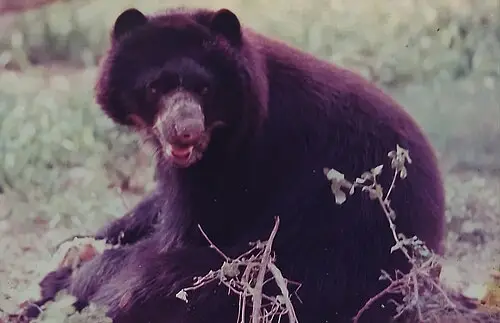
 📸 Photo
Photo: Escarabajo Lunar · CC0 · Wikimedia Commons Source
Andean Bear
Tremarctos ornatus (Andean Bear · メガネグマ)
💡 Everyday Comparisons for Size, Mass & Speed
- 💡 Its maximum weight of 200 kg equals 10 bags of 20 kg rice, and its shoulder height of about 90 cm is taller than a dining table (about 75 cm) (Comparison).
- 💡 It holds great religious and cultural value for Indigenous peoples, and its meat is prized in some areas. Its gallbladder is sold illegally on the East Asian medicine market, though no benefit has been proven (ADW).
Reference standards: coach bus ~12 m, mid-size car ~4.9 m, compact car ~1 t, basketball hoop 3.05 m, credit card 8.56 cm.
Site-computed relative index from recorded values; not a formal scientific metric.
📖 1. Overview
The Andean Bear is the only bear native to South America and lives in cloud forests of the Andes. Its name comes from the glasses-like markings around its eyes.
🦴 2. Anatomy & Morphology
Its fur is mostly black, with white to tan markings encircling the eyes like glasses and sometimes extending down to the chest. These markings differ in each individual like fingerprints. Its tail is short, about 70 mm, and hidden in the fur.
🔍 3. Ecology & Behavior
More herbivorous than any bear except the panda, it favors bromeliads and fruits and also eats moss, cacti, honey, and small animals. It builds feeding platforms in trees, raids cornfields where it may be shot, and does not hibernate.
🇰🇷 4. Connection to Korea
No direct record connecting this species to Korea has been found.
📚 Sources & References
- • IUCN Red List VU (2017) — https://www.iucnredlist.org/species/22066/123792952
- • IUCN Red List category VU — latest assessment at iucnredlist.org
- • mammaldiversity.org — 1005931
- • iucnredlist.org — 123792952
- • wikidata.org — Q137641
- • commons.wikimedia.org — File:Zoológico Paraguaná - Oso frontino Pacheco.jpg
- • animaldiversity.org — Tremarctos ornatus
- • nationalzoo.si.edu — andean-bear
- • Silhouette: PhyloPic — Andy Wilson · CC0 1.0
Recorded dimensions are widely cited representative estimates from public literature and may vary by study or specimen.