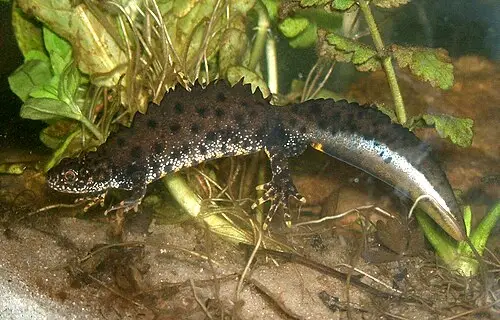
 📸 Photo
Photo: Rainer Theuer. · Public domain · Wikimedia Commons Source
Great Crested Newt
Triturus cristatus (Great Crested Newt · ホクオウクシイモリ)
💡 Everyday Comparisons for Size, Mass & Speed
- 💡 Its length of 17 cm is about twice the long side of a credit card (85.6 mm) (Comparison).
- 💡 It also lives in farm ponds, pools left by gravel and sand pits, and ponds newly dug for wildlife, and is found in rural, urban, and former industrial areas (JNCC).
Reference standards: coach bus ~12 m, mid-size car ~4.9 m, compact car ~1 t, basketball hoop 3.05 m, credit card 8.56 cm.
📖 1. Overview
The Great Crested Newt is the largest native newt in the United Kingdom, with males developing a jagged crest along the back during the breeding season. It is listed as Least Concern (LC, 2023 assessment) on the IUCN Red List.
🦴 2. Anatomy & Morphology
Growing up to about 17 cm in length, it has granular skin containing poison glands that make it distasteful to predators. During its terrestrial phase it is dark gray, brown, or black with a vivid yellow/orange and black pattern on the belly, and breeding males grow a jagged crest along the body and tail.
🔍 3. Ecology & Behavior
In spring it lays eggs singly on pond plants, and larvae grow through the summer before emerging onto land from August to October, taking 2–4 years to reach adulthood. Juveniles and terrestrial-phase adults wander fairly far from breeding sites and form metapopulations linked across multiple ponds.
🇰🇷 4. Connection to Korea
No direct record connecting this species to Korea has been found.
📚 Sources & References
- • IUCN Red List LC (2023) — https://www.iucnredlist.org/species/22212/89706893
- • IUCN Red List category LC — latest assessment at iucnredlist.org
- • catalogueoflife.org — 595F4
- • iucnredlist.org — 89706893
- • wikidata.org — Q138539
- • commons.wikimedia.org — File:Kammmolchmaennchen.jpg
- • sac.jncc.gov.uk — S1166
- • Silhouette: PhyloPic — Luca Leicht · CC BY 4.0
Recorded dimensions are widely cited representative estimates from public literature and may vary by study or specimen.