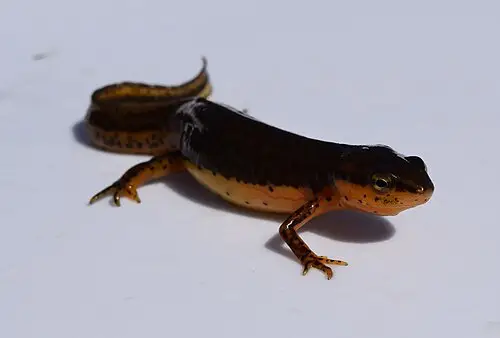
 📸 Photo
Photo: Fredlyfish4 · CC BY-SA 4.0 · Wikimedia Commons Source
Eastern Newt
Notophthalmus viridescens (Eastern Newt · Eastern Newt)
💡 Everyday Comparisons for Size, Mass & Speed
- 💡 Its body length of 12.5 cm is about 1.5 times the long side of a credit card (85.6 mm) (Comparison).
- 💡 It helps keep down numbers of aquatic insects such as mosquitoes, and is sometimes kept as an aquarium or terrarium pet and commercially collected for sale (ADW and Smithsonian's National Zoo).
Reference standards: coach bus ~12 m, mid-size car ~4.9 m, compact car ~1 t, basketball hoop 3.05 m, credit card 8.56 cm.
📖 1. Overview
The Eastern Newt is a newt living in ponds and forests of eastern North America that goes through a three-stage life cycle: aquatic larva, terrestrial juvenile (eft), and aquatic adult. It is listed as Least Concern (LC, 2022 assessment) on the IUCN Red List.
🦴 2. Anatomy & Morphology
Adults have a yellowish or greenish-brown body with black-bordered red spots on the back and a yellow belly dotted with black. The land-dwelling juvenile stage (eft) transforms from a 7–9 mm hatchling into a 3.4–4.5 cm reddish-orange form whose bright color warns predators of its toxicity.
🔍 3. Ecology & Behavior
Carnivorous at every stage, larvae eat water fleas, snails, and beetle larvae, efts eat snails, springtails, and mites in leaf litter, and adults mainly eat aquatic insects such as midge larvae. Breeding begins in late winter to early spring, when males fan their tails to attract females with pheromones and deposit a sperm packet on the pond bottom.
🇰🇷 4. Connection to Korea
No direct record connecting this species to Korea has been found.
📚 Sources & References
- • IUCN Red List LC (2022) — https://www.iucnredlist.org/species/59453/193389835
- • IUCN Red List category LC — latest assessment at iucnredlist.org
- • catalogueoflife.org — 47XFZ
- • iucnredlist.org — 193389835
- • wikidata.org — Q1552306
- • commons.wikimedia.org — File:Notophthalmus viridescens adult female.jpg
- • nationalzoo.si.edu — eastern-newt
- • animaldiversity.org — Notophthalmus viridescens
- • Silhouette: PhyloPic — Beth Reinke · CC0 1.0
Recorded dimensions are widely cited representative estimates from public literature and may vary by study or specimen.