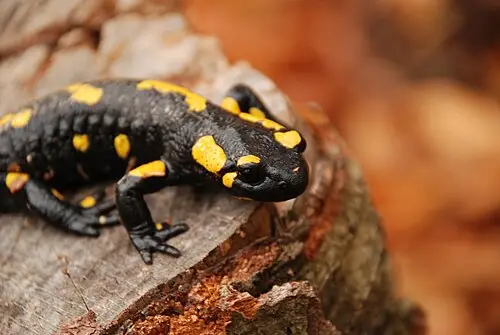
 📸 Photo
Photo: LorikNov · CC BY-SA 3.0 · Wikimedia Commons Source
Fire Salamander
Salamandra salamandra (Fire Salamander · ファイアサラマンダー)
💡 Everyday Comparisons for Size, Mass & Speed
- 💡 Its body length of 30 cm equals the length of a 30 cm ruler, and its average weight of 19.1 g is about that of four sheets of A4 paper (about 5 g each) (Comparison).
- 💡 It has been popular in the pet trade and has also been used as a research animal (ADW, 'Positive Impacts').
Reference standards: coach bus ~12 m, mid-size car ~4.9 m, compact car ~1 t, basketball hoop 3.05 m, credit card 8.56 cm.
Site-computed relative index from recorded values; not a formal scientific metric.
📖 1. Overview
The Fire Salamander is a salamander with vivid yellow or orange markings on a black body, living in shaded forests across Europe and the Middle East. It is assessed as Vulnerable (VU, 2023 assessment) on the IUCN Red List.
🦴 2. Anatomy & Morphology
The largest species in the family Salamandridae, it measures 15–25 cm in body length, with some individuals exceeding 30 cm. Its black body bears yellow or orange markings ranging from spots to large blotches or bands, and it has stout legs and skin toxins.
🔍 3. Ecology & Behavior
A shy animal that feeds on invertebrates such as earthworms, slugs, flies, millipedes, and beetles, it is mainly active on mild nights and stays in the same home range for years. Fertilization takes place on land and females deposit live young in water, and in one study individuals returned to the same cave to hibernate for 20 years.
🇰🇷 4. Connection to Korea
No direct record connecting this species to Korea has been found.
📚 Sources & References
- • IUCN Red List VU (2023) — https://www.iucnredlist.org/species/59467/219148292
- • IUCN Red List category VU — latest assessment at iucnredlist.org
- • catalogueoflife.org — 6XB2G
- • iucnredlist.org — 219148292
- • wikidata.org — Q26395
- • commons.wikimedia.org — File:Саламандра.JPG
- • animaldiversity.org — Salamandra salamandra
- • Silhouette: PhyloPic — Beth Reinke · CC0 1.0
Recorded dimensions are widely cited representative estimates from public literature and may vary by study or specimen.