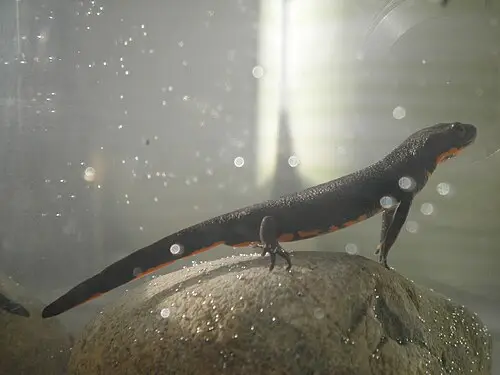
 📸 Photo
Photo: Kennyannydenny · CC BY-SA 3.0 · Wikimedia Commons Source
Chinese Fire-bellied Newt
Hypselotriton orientalis (Chinese Fire-bellied Newt · チュウゴクイモリ)
💡 Everyday Comparisons for Size, Mass & Speed
- 💡 Commonly found in rice paddies and puddles at elevations of 30–1,000 m, human-made rice paddies often serve as a home for this newt.
- 💡 Because the red pattern on its belly is attractive, it is illegally traded in domestic and international pet markets, which is cited as a threat alongside habitat destruction.
Reference standards: coach bus ~12 m, mid-size car ~4.9 m, compact car ~1 t, basketball hoop 3.05 m, credit card 8.56 cm.
📖 1. Overview
The Chinese Fire-bellied Newt is a newt found only in the mountains of east-central China and is commonly seen in rice paddies and puddles. It is listed as Least Concern (LC, 2020 assessment) on the IUCN Red List.
🦴 2. Anatomy & Morphology
True to its name, it is called a 'fire-bellied' newt, and a taxonomic revision paper distinguishes populations by markings such as rusty red spots on the back, an orange-red spot on the first finger, and black stripes on the belly. No body length figures were found in the official sources consulted.
🔍 3. Ecology & Behavior
It lives near slow-moving water such as ponds, streams, and wetlands in hills and low mountains, and is adaptable enough to use rice paddies and puddles as new habitats. However, researchers note that paddies and puddles are vulnerable to environmental change so mountain stream populations also need attention, and habitat destruction and illegal pet-market trade are cited as threats.
🇰🇷 4. Connection to Korea
No direct record connecting this species to Korea has been found.
📚 Sources & References
- • IUCN Red List LC (2020) — https://www.iucnredlist.org/species/59442
- • IUCN Red List category LC — latest assessment at iucnredlist.org
- • catalogueoflife.org — 3P3CB
- • iucnredlist.org — 59442
- • wikidata.org — Q28021355
- • commons.wikimedia.org — File:Cynops orientalis.JPG
- • pmc.ncbi.nlm.nih.gov — PMC13139859
- • pmc.ncbi.nlm.nih.gov — PMC8328465
- • Silhouette: PhyloPic — Kai Caspar · CC0 1.0 (Congeneric silhouette — Cynops pyrrhogaster)
Recorded dimensions are widely cited representative estimates from public literature and may vary by study or specimen.