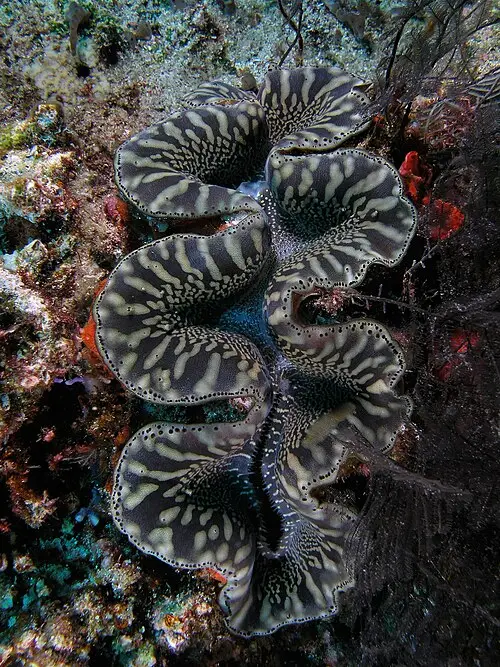
 📸 Photo
Photo: Nhobgood Nick Hobgood · CC BY-SA 3.0 · Wikimedia Commons Source
Giant clam
Tridacna gigas (Giant clam · オオシャコガイ)
💡 Everyday Comparisons for Size, Mass & Speed
- 💡 Its maximum shell length of 1.5 m is just under the width of a passenger car (about 1.8 m) (Comparison).
- 💡 Its maximum weight of 500 kg is equal to the weight of 25 bags of 20 kg rice (Comparison).
- 💡 Farmed giant clams are sold for food (the adductor muscle is a delicacy) and for the ornamental aquarium trade (ADW positive impacts for humans).
Reference standards: coach bus ~12 m, mid-size car ~4.9 m, compact car ~1 t, basketball hoop 3.05 m, credit card 8.56 cm.
Site-computed relative index from recorded values; not a formal scientific metric.
📖 1. Overview
The giant clam is the largest living bivalve mollusk. It lives in shallow areas of Indo-Pacific coral reefs.
🦴 2. Anatomy & Morphology
Its shell is thick and heavy with 4–5 triangular projections along the opening, and its mantle gleams with blue, purple, or green spots on a yellow, brown, or green background.
🔍 3. Ecology & Behavior
As a sessile clam that stays in one place, it can filter-feed from water, but it gets most of its nutrition from symbiotic algae (zooxanthellae) living inside its tissues. When disturbed, it retracts its mantle and closes its shell.
🇰🇷 4. Connection to Korea
No direct record connecting this species to Korea has been found.
📚 Sources & References
- • IUCN Red List CR (2024) — https://www.iucnredlist.org/species/22137/119167161
- • IUCN Red List category CR — latest assessment at iucnredlist.org
- • marinespecies.org — aphia.php
- • iucnredlist.org — 119167161
- • wikidata.org — Q751784
- • commons.wikimedia.org — File:Giant clam black&white komodo.jpg
- • animaldiversity.org — Tridacna gigas
- • sealifebase.se — Tridacna-gigas.html
- • Silhouette: PhyloPic — Jimmy Bernot · CC0 1.0 (Congeneric silhouette — Tridacna)
Recorded dimensions are widely cited representative estimates from public literature and may vary by study or specimen.