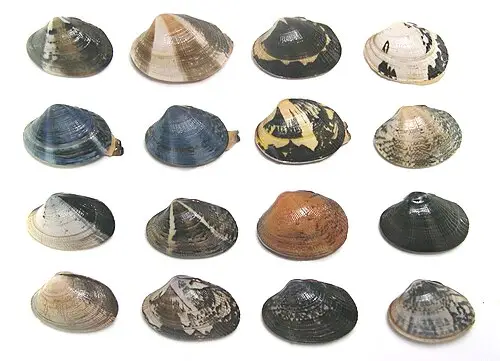
 📸 Photo
Photo: Public domain · Public domain · Wikimedia Commons Source
Manila clam
Ruditapes philippinarum (Manila clam · アサリ)
Not Evaluated (NE) on the IUCN Red List yet.
💡 Everyday Comparisons for Size, Mass & Speed
- 💡 Its common length of 5 cm is similar to the length of two Korean 500-won coins (diameter about 2.65 cm) placed side by side (Comparison).
- 💡 It is the most widely eaten clam in Korea, abundant in the wild and also extensively farmed (National List of Species of Korea).
Reference standards: coach bus ~12 m, mid-size car ~4.9 m, compact car ~1 t, basketball hoop 3.05 m, credit card 8.56 cm.
📖 1. Overview
The Manila clam is a bivalve that burrows into sandy mud on tidal flats and is the most widely eaten clam species in Korea.
🦴 2. Anatomy & Morphology
Its shell is elongate-oval, hard, and pale yellowish-brown with diverse patterns. Because its siphons are short, it burrows only about 10 cm deep.
🔍 3. Ecology & Behavior
It is a filter feeder that strains water to obtain food. Because it moves slowly and does not stray far from its habitat, it is well suited to aquaculture; its spawning season is July–August, and its maximum recorded lifespan is 14 years.
🇰🇷 4. Connection to Korea
It is listed on the National List of Species of Korea under the name Bajirak (Korean name) and lives along coasts nationwide, though it is especially abundant on the west and south coasts. It is the most widely consumed shellfish in Korea.
📚 Sources & References
- • IUCN Red List: not evaluated (NE) — cross-checked with the Wikidata conservation-status entry
- • marinespecies.org — aphia.php
- • 국가생물종목록(국립생물자원관) ktsn 120000044081 — https://species.nibr.go.kr/home/mainHome.do?cont_link=009&subMenu=009002&contCd=009002&ktsn=120000044081
- • wikidata.org — Q15703958
- • commons.wikimedia.org — File:Ruditapes philippinarum.jpg
- • sealifebase.se — Ruditapes-philippinarum.html
- • species.nibr.go.kr — mainHome.do
- • Silhouette: PhyloPic — Harold N Eyster · CC BY 3.0 (Related taxon silhouette — Leukoma staminea)
Recorded dimensions are widely cited representative estimates from public literature and may vary by study or specimen.