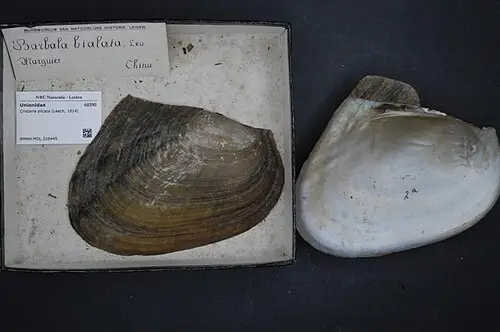
 📸 Photo
Photo: Leach, 1814 · CC0 · Wikimedia Commons Source
Cockscomb mussel
Cristaria plicata (Cockscomb mussel · カラスガイ)
🇰🇷 Class I endangered wildlife (Korea)
💡 Everyday Comparisons for Size, Mass & Speed
- 💡 During the Japanese colonial period, it was reportedly used in the Nakdong River as a mother mussel for culturing pearls (National Institute of Ecology).
- 💡 Because this mussel is threatened when drought lowers water levels or when host fish for its larvae decline (National Institute of Ecology), managing water and protecting fish in local streams helps conserve it.
- 💡 Its shell length of 18 cm is slightly shorter than the short side of an A4 sheet of paper (21 cm) (Comparison).
Reference standards: coach bus ~12 m, mid-size car ~4.9 m, compact car ~1 t, basketball hoop 3.05 m, credit card 8.56 cm.
📖 1. Overview
The cockscomb mussel is the largest freshwater mussel species in Korea, living in muddy-bottomed swamps and rivers.
🦴 2. Anatomy & Morphology
Its shell is an elongated oval, thick and black, with a pearly luster on the inside. The areas in front of and behind the umbo project like ears, though the front wing wears down with age, leaving only the rear wing.
🔍 3. Ecology & Behavior
It feeds on microscopic organic matter such as zooplankton and phytoplankton. Larvae released from the mother's shell attach to fish gills or fins and drop off after about 3 years when they take on the adult form.
🇰🇷 4. Connection to Korea
It is designated as Class I endangered wildlife (Korea) and is distributed mainly in the middle and lower reaches of the Nakdong River. During the Japanese colonial period, it was reportedly used in the Nakdong River as a mother shell for pearl culture.
📚 Sources & References
- • IUCN Red List LC (2019) — https://www.iucnredlist.org/species/166309/98189722
- • 멸종위기 야생생물 Ⅰ급 — 국가생물종목록(국립생물자원관) ktsn 120000043776 — https://species.nibr.go.kr/home/mainHome.do?cont_link=009&subMenu=009002&contCd=009002&ktsn=120000043776
- • IUCN Red List category LC — latest assessment at iucnredlist.org
- • Korean protection status: Class I endangered wildlife (Korea)
- • catalogueoflife.org — ZHZH
- • iucnredlist.org — 98189722
- • 국가생물종목록(국립생물자원관) ktsn 120000043776 — https://species.nibr.go.kr/home/mainHome.do?cont_link=009&subMenu=009002&contCd=009002&ktsn=120000043776
- • wikidata.org — Q18348116
- • commons.wikimedia.org — File:Naturalis Biodiversity Center - RMNH.MOL.326445 - Crist
- • nie.re.kr — view.do
- • Silhouette: PhyloPic — Lena Lowis · Public Domain Mark 1.0 (Congeneric silhouette — Combretum indicum)
Recorded dimensions are widely cited representative estimates from public literature and may vary by study or specimen.