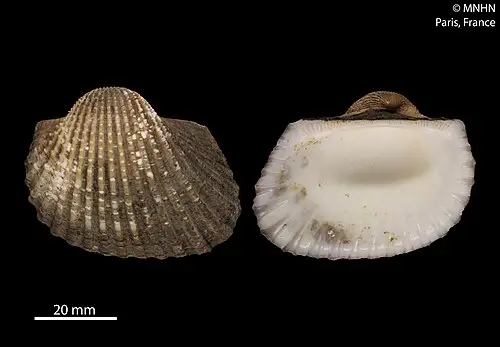
 📸 Photo
Photo: Marie HENNION · CC BY 4.0 · Wikimedia Commons Source
Blood cockle
Tegillarca granosa (Blood cockle · ハイガイ)
Not Evaluated (NE) on the IUCN Red List yet.
💡 Everyday Comparisons for Size, Mass & Speed
- 💡 Its common shell length of 6 cm is slightly longer than two Korean 500-won coins (diameter about 2.65 cm) placed side by side (Comparison).
- 💡 It is a representative farmed bivalve raised by bottom seeding around Beolgyo in Jeollanam-do (National List of Species of Korea).
- 💡 It appears as a delicacy in Jasaneobo and has been known since olden times as a local specialty of Jeolla-do (National List of Species of Korea).
Reference standards: coach bus ~12 m, mid-size car ~4.9 m, compact car ~1 t, basketball hoop 3.05 m, credit card 8.56 cm.
📖 1. Overview
The blood cockle is a bivalve that burrows shallowly into tidal flat mud in warm, shallow seas and is widely distributed across the Indo-Pacific.
🦴 2. Anatomy & Morphology
Its shell has 17–18 radial ribs (vertical ridges) bearing small nodules. It is distinguished from Saekkomak (a Korean animal name), which has 30–34 radial ribs.
🔍 3. Ecology & Behavior
It filter-feeds on organic detritus and phytoplankton and often forms dense beds. Sexes are separate, spawning occurs mainly in July–August, and its maximum recorded lifespan is 12 years.
🇰🇷 4. Connection to Korea
It is listed on the National List of Species of Korea under the name Kkomak (Korean name) and lives along the south and west coasts. It is farmed mainly along the south coast of Jeollanam-do, especially around Beolgyo, and is also introduced as a delicacy in Jasaneobo.
📚 Sources & References
- • IUCN Red List: not evaluated (NE) — cross-checked with the Wikidata conservation-status entry
- • marinespecies.org — aphia.php
- • 국가생물종목록(국립생물자원관) ktsn 120000043485 — https://species.nibr.go.kr/home/mainHome.do?cont_link=009&subMenu=009002&contCd=009002&ktsn=120000043485
- • wikidata.org — Q11282677
- • commons.wikimedia.org — File:Tegillarca granosa (MNHN-IM-2012-24836) 001.jpeg
- • sealifebase.se — Tegillarca-granosa.html
- • species.nibr.go.kr — mainHome.do
- • Silhouette: PhyloPic — Katie S. Collins · CC0 1.0 (Related taxon silhouette — Arca noae)
Recorded dimensions are widely cited representative estimates from public literature and may vary by study or specimen.