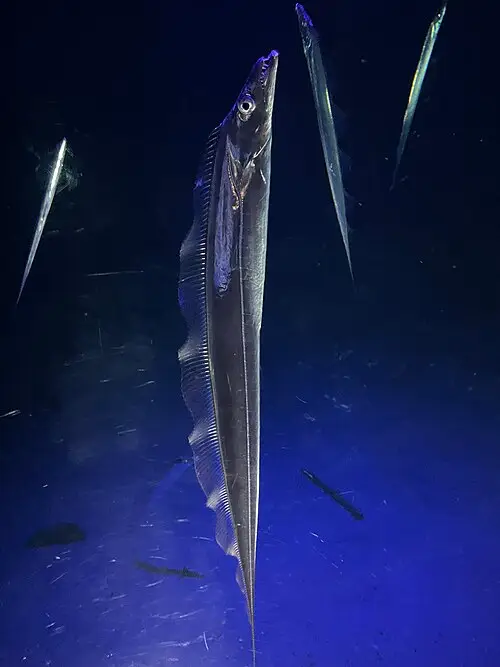
 📸 Photo
Photo: Totti · CC BY-SA 4.0 · Wikimedia Commons Source
Largehead hairtail
Trichiurus lepturus (Largehead hairtail · タチウオ)
💡 Everyday Comparisons for Size, Mass & Speed
- 💡 Korea's National Institute of Fisheries Science analyzed in 2017 data that distinct fishing grounds for the largehead hairtail form off the coast of Jeju when water temperatures at 20 m depth are 21–23 °C.
- 💡 Its common length of 100 cm on FishBase is slightly longer than a single umbrella (Comparison).
Reference standards: coach bus ~12 m, mid-size car ~4.9 m, compact car ~1 t, basketball hoop 3.05 m, credit card 8.56 cm.
📖 1. Overview
The largehead hairtail is a marine fish living in tropical to temperate seas worldwide, and in Korea it is caught in large numbers around Jeju and the South Sea.
🦴 2. Anatomy & Morphology
It is known to reach a maximum total length of 234 cm, with a common length of around 100 cm.
🔍 3. Ecology & Behavior
Adults mainly feed on fish as well as squid and crustaceans, and large adults feed near the surface during the day and move down to the bottom at night.
🇰🇷 4. Connection to Korea
It is listed on the National List of Species of Korea (National Institute of Biological Resources (NIBR)), and according to the National Institute of Fisheries Science, coastal composite fishery catches of this species along the southern coast including Jeju peaked at 12,212 tons in 2008 and declined to 3,957 tons in 2024.
📚 Sources & References
- • IUCN Red List LC (2015) — https://www.iucnredlist.org/species/190090/115307118
- • IUCN Red List category LC — latest assessment at iucnredlist.org
- • catalogueoflife.org — 589FX
- • iucnredlist.org — 115307118
- • 국가생물종목록(국립생물자원관) ktsn 120000059152 — https://species.nibr.go.kr/home/mainHome.do?cont_link=009&subMenu=009002&contCd=009002&ktsn=120000059152
- • wikidata.org — Q1139971
- • commons.wikimedia.org — File:Trichiurus lepturus Umitamago.jpg
- • fishbase.se — Trichiurus-lepturus.html
- • species.nibr.go.kr — general-search
- • nifs.go.kr — actionNewsView.do
Recorded dimensions are widely cited representative estimates from public literature and may vary by study or specimen.