 📸 Photo
Photo: Public domain · Public domain · Wikimedia Commons Source
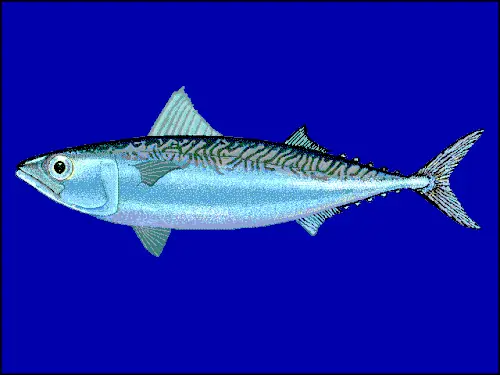
Pacific chub mackerel
Scomber japonicus (Pacific chub mackerel · マサバ)
💡 Everyday Comparisons for Size, Mass & Speed
- 💡 Its common body length of 30 cm is almost the same as the long side of an A4 sheet of paper (29.7 cm) (Comparison).
- 💡 It can be seen throughout Korean waters and migrates north and south between Jeju Island and the Yellow and East Seas with the seasons (National List of Species of Korea).
- 💡 It is a fish widely used in commercial fisheries, aquaculture, angling, and as bait (FishBase).
Reference standards: coach bus ~12 m, mid-size car ~4.9 m, compact car ~1 t, basketball hoop 3.05 m, credit card 8.56 cm.
Site-computed relative index from recorded values; not a formal scientific metric.
📖 1. Overview
The Pacific chub mackerel is a marine fish living in large schools in coastal surface waters and can be seen throughout Korean waters. It migrates north and south depending on water temperature.
🦴 2. Anatomy & Morphology
Its body is streamlined with an oval cross-section, and it has a swim bladder. The back is pale blue with wavy stripes, and the belly is spotless silvery-white.
🔍 3. Ecology & Behavior
It stays near the bottom during the day and rises to the surface at night to feed on water fleas, crustaceans, fish, and squid. It spawns in groups with floating eggs and larvae, and its maximum lifespan is 18 years.
🇰🇷 4. Connection to Korea
According to the National List of Species of Korea, it lives throughout Korean waters, migrating north from Jeju Island into the Yellow Sea and East Sea around February to March, then moving south between September and January of the following year.
📚 Sources & References
- • IUCN Red List LC (2023) — https://www.iucnredlist.org/species/170306/170083106
- • IUCN Red List category LC — latest assessment at iucnredlist.org
- • catalogueoflife.org — 79XK5
- • iucnredlist.org — 170083106
- • 국가생물종목록(국립생물자원관) ktsn 120000059167 — https://species.nibr.go.kr/home/mainHome.do?cont_link=009&subMenu=009002&contCd=009002&ktsn=120000059167
- • wikidata.org — Q815837
- • commons.wikimedia.org — File:Scjap u0.gif
- • fishbase.se — Scomber-japonicus.html
- • species.nibr.go.kr — mainHome.do
- • Silhouette: PhyloPic — author not recorded · CC0 1.0
Recorded dimensions are widely cited representative estimates from public literature and may vary by study or specimen.