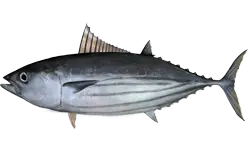
 📸 Photo
Photo: Unknown author Unknown author · Public domain · Wikimedia Commons Source
Skipjack tuna
Katsuwonus pelamis (Skipjack tuna · カツオ)
💡 Everyday Comparisons for Size, Mass & Speed
- 💡 An average weight of 8 to 10 kg is about one 10 kg bag of rice, and its maximum weight of 34.5 kg is about one and a half 20 kg bags of rice (Comparison).
- 💡 More than 1.67 million tons were caught in 1991, accounting for about 40% of the global tuna catch (Animal Diversity Web).
- 💡 People in the United States consume more than 400,000 tons of tuna (all species combined) each year (Animal Diversity Web).
Reference standards: coach bus ~12 m, mid-size car ~4.9 m, compact car ~1 t, basketball hoop 3.05 m, credit card 8.56 cm.
Site-computed relative index from recorded values; not a formal scientific metric.
📖 1. Overview
The skipjack tuna is a schooling tuna species roaming the surface waters of tropical and temperate seas. Although the smallest species targeted in major tuna fisheries, it accounts for about 40% of the global tuna catch by weight.
🦴 2. Anatomy & Morphology
It has a typical tuna-like elongated spindle-shaped body. Scales are present only along the lateral line and corselet (chest region); the back is purplish-blue and the sides and belly are silvery.
🔍 3. Ecology & Behavior
It is an opportunistic predator feeding indiscriminately on fishes, crustaceans, and mollusks. It schools with other tunas, whales, or sharks, gathers beneath floating objects, and spawns year-round near the equator.
🇰🇷 4. Connection to Korea
It is listed as “Gadarangeo” (Korean name) in the National List of Species of Korea.
📚 Sources & References
- • IUCN Red List LC (2021) — https://www.iucnredlist.org/species/170310/46644566
- • IUCN Red List category LC — latest assessment at iucnredlist.org
- • catalogueoflife.org — 3R3XY
- • iucnredlist.org — 46644566
- • 국가생물종목록(국립생물자원관) ktsn 120000059162 — https://species.nibr.go.kr/home/mainHome.do?cont_link=009&subMenu=009002&contCd=009002&ktsn=120000059162
- • wikidata.org — Q633957
- • commons.wikimedia.org — File:Katsuwonus pelamis.png
- • fishbase.se — Katsuwonus-pelamis.html
- • animaldiversity.org — Katsuwonus pelamis
- • Silhouette: PhyloPic — John E. Randall (vectorized by Russell Engelman) · CC BY 4.0
Recorded dimensions are widely cited representative estimates from public literature and may vary by study or specimen.