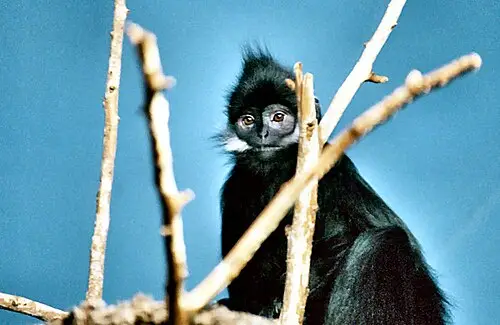
 📸 Photo
Photo: Lea Maimone · CC BY-SA 2.5 · Wikimedia Commons Source
François's Langur
Trachypithecus francoisi (François's Langur · フランソワルトン)
💡 Everyday Comparisons for Size, Mass & Speed
- 💡 Its maximum weight of 14 kg is about 70% of a 20 kg bag of rice (Comparison).
- 💡 It has been used to study retroviruses that can also infect humans, and it has been hunted for its believed medicinal value (ADW, Economic Importance for Humans: Positive).
Reference standards: coach bus ~12 m, mid-size car ~4.9 m, compact car ~1 t, basketball hoop 3.05 m, credit card 8.56 cm.
Site-computed relative index from recorded values; not a formal scientific metric.
📖 1. Overview
François's Langur is a leaf-eating monkey living in dense forests of limestone regions that leaps agilely from tree to tree.
🦴 2. Anatomy & Morphology
It has a small head without cheek pouches, white stripes running from the corners of its mouth to its ears, and eyebrow-like white hair. Young are golden yellow, and the tail is long and straight.
🔍 3. Ecology & Behavior
It feeds mainly on mature leaves along with small amounts of fruit and insects. To digest low-nutrient leaves, it has a large multi-chambered stomach where bacteria break down plant fibers.
🇰🇷 4. Connection to Korea
No direct record connecting this species to Korea has been found.
📚 Sources & References
- • IUCN Red List EN (2020) — https://www.iucnredlist.org/species/39853/17958817
- • IUCN Red List category EN — latest assessment at iucnredlist.org
- • mammaldiversity.org — 1000702
- • iucnredlist.org — 17958817
- • wikidata.org — Q545897
- • commons.wikimedia.org — File:Trachypithecus francoisi 3398.jpg
- • animaldiversity.org — Trachypithecus francoisi
- • Silhouette: PhyloPic — Andy Wilson · CC0 1.0
Recorded dimensions are widely cited representative estimates from public literature and may vary by study or specimen.