 📸 Photo
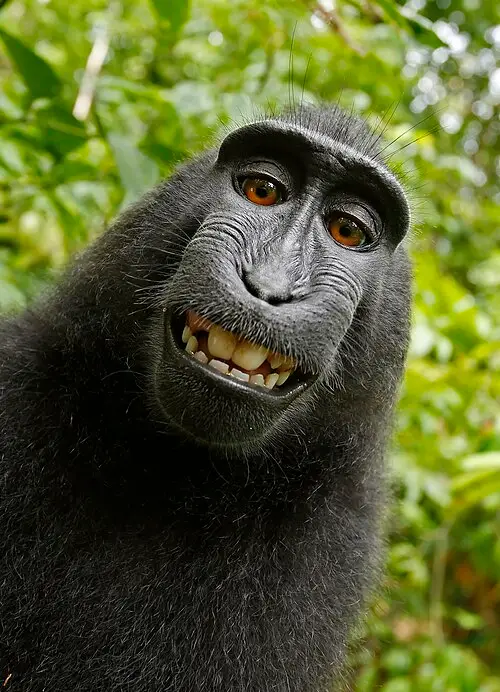
Photo: Self-portrait by the depicted Macaca nigra female. See article . · Public domain · Wikimedia Commons Source
Crested Macaque
Macaca nigra (Crested Macaque · クロザル)
💡 Everyday Comparisons for Size, Mass & Speed
- 💡 Its maximum weight of 18 kg is close to a single 20 kg bag of rice (Comparison).
- 💡 Its body length of 57 cm is about two and a half times the diameter of a basketball (about 24 cm) (Comparison).
- 💡 As a non-human primate model for Type 2 diabetes, it is valuable in research, and in some areas it is also hunted as a holiday delicacy (ADW positive impacts).
Reference standards: coach bus ~12 m, mid-size car ~4.9 m, compact car ~1 t, basketball hoop 3.05 m, credit card 8.56 cm.
Site-computed relative index from recorded values; not a formal scientific metric.
📖 1. Overview
The Crested Macaque is a macaque living only on the island of Sulawesi, with an all-black body and crown hair that rises backward like a crest.
🦴 2. Anatomy & Morphology
Its face is black with a baboon-like protruding muzzle, and its body hair is coarse and thick. Because its tail is only about 20 mm long, it is sometimes mistaken for an ape.
🔍 3. Ecology & Behavior
It feeds mainly on fruits such as figs, and also eats insects, bats, lizards, frogs, and bird eggs. It forms relatively large groups of 50–97 individuals, with females staying in their natal group and males dispersing to other groups.
🇰🇷 4. Connection to Korea
No direct record connecting this species to Korea has been found.
📚 Sources & References
- • IUCN Red List CR (2020) — https://www.iucnredlist.org/species/12556/17950422
- • IUCN Red List category CR — latest assessment at iucnredlist.org
- • mammaldiversity.org — 1000615
- • iucnredlist.org — 17950422
- • wikidata.org — Q280590
- • commons.wikimedia.org — File:Macaca nigra self-portrait large.jpg
- • animaldiversity.org — Macaca nigra
- • Silhouette: PhyloPic — Jamie Whitehouse · CC0 1.0
Recorded dimensions are widely cited representative estimates from public literature and may vary by study or specimen.