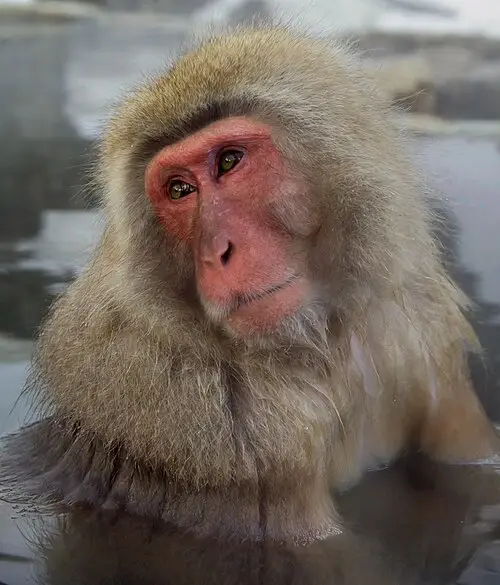
 📸 Photo
Photo: Fg2 ( talk · contribs ) · Public domain · Wikimedia Commons Source
Japanese Macaque
Macaca fuscata (Japanese Macaque · ニホンザル)
💡 Everyday Comparisons for Size, Mass & Speed
- 💡 In the Shiga Highlands of Honshu, a troop has been observed soaking in a human-modified volcanic hot spring to warm up.
- 💡 The behavior of washing sweet potatoes at the seashore before eating was reported to have spread through a troop.
- 💡 In Japan, it ranks right after wild boars and deer among animals causing crop damage.
Reference standards: coach bus ~12 m, mid-size car ~4.9 m, compact car ~1 t, basketball hoop 3.05 m, credit card 8.56 cm.
Site-computed relative index from recorded values; not a formal scientific metric.
📖 1. Overview
The Japanese Macaque lives across the Japanese archipelago and is notable for inhabiting cold, snowy regions.
🦴 2. Anatomy & Morphology
It has thick fur against the cold, a short tail, and a pinkish-red face and rump.
🔍 3. Ecology & Behavior
An omnivore that eats fruits, flowers, leaves, seeds, and mushrooms according to the season, it forms female-centered troops while males leave the troop when grown.
🇰🇷 4. Connection to Korea
No direct record connecting this species to Korea has been found.
📚 Sources & References
- • IUCN Red List LC (2020) — https://www.iucnredlist.org/species/12552/195347803
- • IUCN Red List category LC — latest assessment at iucnredlist.org
- • mammaldiversity.org — 1000607
- • iucnredlist.org — 195347803
- • wikidata.org — Q191781
- • commons.wikimedia.org — File:JapaneseMacaqueM2186.jpg
- • animaldiversity.org — Macaca fuscata
- • Silhouette: PhyloPic — Matthew Schmitz · CC0 1.0 (Congeneric silhouette — Macaca mulatta)
Recorded dimensions are widely cited representative estimates from public literature and may vary by study or specimen.