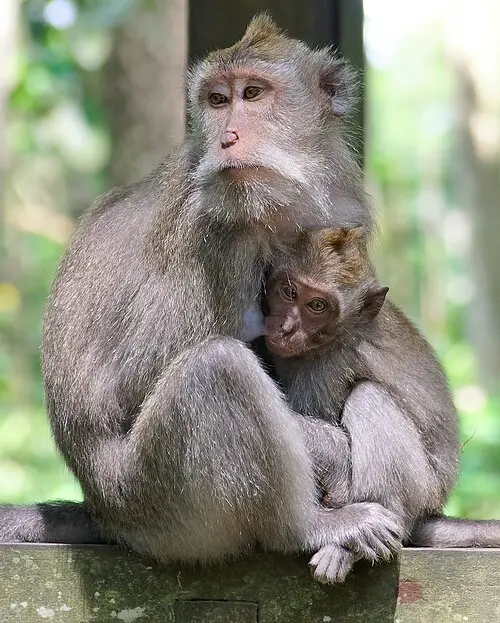
 📸 Photo
Photo: Jakub Hałun · CC BY-SA 4.0 · Wikimedia Commons Source
Long-tailed Macaque
Macaca fascicularis (Long-tailed Macaque · カニクイザル)
💡 Everyday Comparisons for Size, Mass & Speed
- 💡 Its maximum weight of 7 kg is about 1/3 of a 20 kg bag of rice (Comparison).
- 💡 It is used as a laboratory animal in immunology, surgery, toxicology, and pharmacology research, is still hunted for food in some areas, and also serves as an ecotourism attraction (ADW positive impacts).
Reference standards: coach bus ~12 m, mid-size car ~4.9 m, compact car ~1 t, basketball hoop 3.05 m, credit card 8.56 cm.
Site-computed relative index from recorded values; not a formal scientific metric.
📖 1. Overview
The Long-tailed Macaque is a highly adaptable macaque that thrives along forest edges, in mangrove swamps, and in human-disturbed forests of Southeast Asia.
🦴 2. Anatomy & Morphology
Its body fur is grayish-brown to reddish-brown with a paler underside, and its face has cheek whiskers. Its tail is longer than its body, measuring 50–60 cm.
🔍 3. Ecology & Behavior
An omnivore that eats mostly fruit along with crabs, flowers, insects, leaves, fungi, grasses, and even clay, adult males leave their natal group to join other groups.
🇰🇷 4. Connection to Korea
No direct record connecting this species to Korea has been found.
📚 Sources & References
- • IUCN Red List EN (2025) — https://www.iucnredlist.org/species/12551/273015436
- • IUCN Red List category EN — latest assessment at iucnredlist.org
- • mammaldiversity.org — 1000606
- • iucnredlist.org — 273015436
- • wikidata.org — Q301676
- • commons.wikimedia.org — File:Macaca fascicularis, Ubud Monkey Forest, Bali, 20220822
- • animaldiversity.org — Macaca fascicularis
- • Silhouette: PhyloPic — Jamie Whitehouse · CC0 1.0
Recorded dimensions are widely cited representative estimates from public literature and may vary by study or specimen.