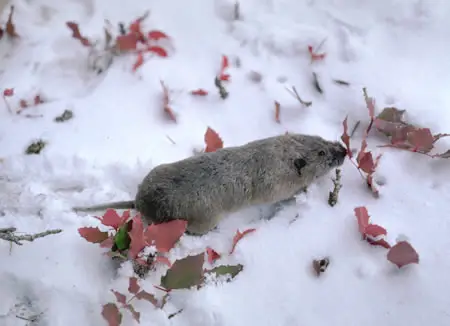
 📸 Photo
Photo: Public domain · Public domain · Wikimedia Commons Source
Northern Pocket Gopher
Thomomys talpoides (Northern Pocket Gopher · Northern Pocket Gopher)
💡 Everyday Comparisons for Size, Mass & Speed
- 💡 Its maximum weight of 160 g is about three eggs (about 60 g each), and its length of 26 cm is slightly shorter than a 30 cm ruler (Comparison).
- 💡 A 31-year study in Utah, USA found that soil inhabited by this gopher had increased porosity, organic matter, nitrogen, and phosphorus, helping soil fertility in farmland and pastures over the long term (Animal Diversity Web).
Reference standards: coach bus ~12 m, mid-size car ~4.9 m, compact car ~1 t, basketball hoop 3.05 m, credit card 8.56 cm.
Site-computed relative index from recorded values; not a formal scientific metric.
📖 1. Overview
The Northern Pocket Gopher is a small rodent living in underground burrows and is found in a wider variety of environments than any other pocket gopher.
🦴 2. Anatomy & Morphology
With a thick, tapering body, short legs, strong claws, loose skin, and small eyes and ears, it is well suited for digging. Its incisors are sharp and fast-growing, and its cheek pouches open on the outside of the body.
🔍 3. Ecology & Behavior
An herbivore that mainly eats grasses, roots, bulbs, rhizomes, and stems, it sometimes pulls entire plants underground. It lives alone, is strongly territorial, and digs elaborate tunnels.
🇰🇷 4. Connection to Korea
No direct record connecting this species to Korea has been found.
📚 Sources & References
- • IUCN Red List LC (2016) — https://www.iucnredlist.org/species/42597/115193142
- • IUCN Red List category LC — latest assessment at iucnredlist.org
- • mammaldiversity.org — 1001886
- • iucnredlist.org — 115193142
- • wikidata.org — Q1769015
- • commons.wikimedia.org — File:Thomomys talpoides.jpg
- • animaldiversity.org — Thomomys talpoides
- • Silhouette: PhyloPic — Xavier A. Jenkins · CC0 1.0 (Related taxon silhouette — Geomys bursarius)
Recorded dimensions are widely cited representative estimates from public literature and may vary by study or specimen.