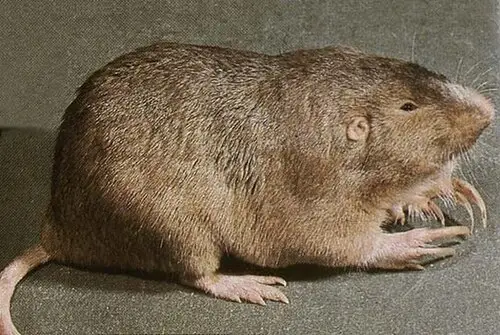
 📸 Photo
Photo: Unknown author Unknown author · Public domain · Wikimedia Commons Source
Plains Pocket Gopher
Geomys bursarius (Plains Pocket Gopher · Plains Pocket Gopher)
💡 Everyday Comparisons for Size, Mass & Speed
- 💡 Its maximum weight of 450 g is similar to one 500 mL bottle of water (about 0.5 kg), and its body length of 35.7 cm is nearly a handspan longer than a 30 cm ruler (Comparison).
- 💡 Its burrows can be spotted by mounds of soil piled beside the entrances, and they aerate the soil and improve drainage, helping reduce flooding to some extent (Animal Diversity Web).
Reference standards: coach bus ~12 m, mid-size car ~4.9 m, compact car ~1 t, basketball hoop 3.05 m, credit card 8.56 cm.
Site-computed relative index from recorded values; not a formal scientific metric.
📖 1. Overview
The Plains Pocket Gopher is a solitary rodent that digs burrows in sandy soils of the North American plains.
🦴 2. Anatomy & Morphology
Its short fur ranges from pale brown to black with a generally paler belly. It has a heavily reinforced skull, strong jaw muscles, and large, fast-growing front claws.
🔍 3. Ecology & Behavior
It feeds mainly on underground roots and tubers and occasionally on aboveground plants, getting enough water from its food that it rarely drinks. Females usually give birth to 1–3 young per litter from April to July.
🇰🇷 4. Connection to Korea
No direct record connecting this species to Korea has been found.
📚 Sources & References
- • IUCN Red List LC (2016) — https://www.iucnredlist.org/species/42588/115192675
- • IUCN Red List category LC — latest assessment at iucnredlist.org
- • mammaldiversity.org — 1001858
- • iucnredlist.org — 115192675
- • wikidata.org — Q1426222
- • commons.wikimedia.org — File:Geomys bursarius.jpg
- • animaldiversity.org — Geomys bursarius
- • Silhouette: PhyloPic — Xavier A. Jenkins · CC0 1.0
Recorded dimensions are widely cited representative estimates from public literature and may vary by study or specimen.