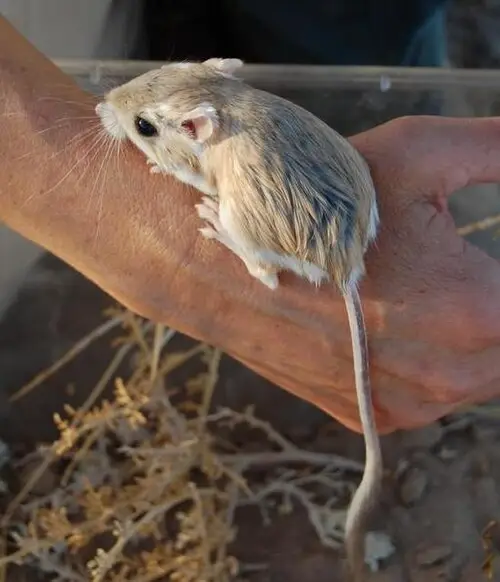
 📸 Photo
Photo: Baiken · CC BY-SA 3.0 · Wikimedia Commons Source
Merriam's Kangaroo Rat
Dipodomys merriami (Merriam's Kangaroo Rat · Merriam's Kangaroo Rat)
💡 Everyday Comparisons for Size, Mass & Speed
- 💡 Its maximum weight of 50 g is lighter than one chicken egg (about 60 g), and its average total length of 24.7 cm is slightly longer than the short side of A4 paper (21 cm) (Comparison).
- 💡 It plays a major role in dispersing seeds in arid regions, and its burrowing is thought to aerate and fertilize the soil (Animal Diversity Web).
Reference standards: coach bus ~12 m, mid-size car ~4.9 m, compact car ~1 t, basketball hoop 3.05 m, credit card 8.56 cm.
Site-computed relative index from recorded values; not a formal scientific metric.
📖 1. Overview
Merriam's Kangaroo Rat is a small desert rodent of southwestern North America that eats seeds and digs burrows in sandy ground.
🦴 2. Anatomy & Morphology
It has a long tail with a tufted tip and large hind feet (39 mm) with hairy soles. It carries seeds in fur-lined cheek pouches, and its belly is white and silky.
🔍 3. Ecology & Behavior
Seeds of plants such as mesquite and creosote bush make up almost all of its diet, with insects eaten occasionally. Solitary and nocturnal, it kicks sand into a predator's face when threatened.
🇰🇷 4. Connection to Korea
No direct record connecting this species to Korea has been found.
📚 Sources & References
- • IUCN Red List LC (2016) — https://www.iucnredlist.org/species/92465716/115515430
- • IUCN Red List category LC — latest assessment at iucnredlist.org
- • mammaldiversity.org — 1001897
- • iucnredlist.org — 115515430
- • wikidata.org — Q304884
- • commons.wikimedia.org — File:Dipodomys merriami.JPG
- • animaldiversity.org — Dipodomys merriami
- • Silhouette: PhyloPic — author not recorded · CC0 1.0 (Congeneric silhouette — Dipodomys)
Recorded dimensions are widely cited representative estimates from public literature and may vary by study or specimen.