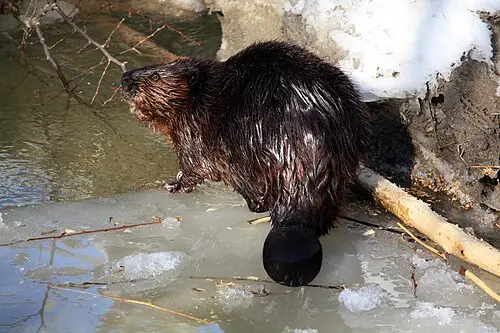
 📸 Photo
Photo: Vlad Podvorny · CC BY 2.0 · Wikimedia Commons Source
North American Beaver
Castor canadensis (North American Beaver · アメリカビーバー)
💡 Everyday Comparisons for Size, Mass & Speed
- 💡 Its maximum weight of 32 kg is just over three 10 kg bags of rice, and its length of 1.17 m is similar to the height of a 1st-grade elementary school child (about 1.2 m) (Comparison).
- 💡 By building dams, beavers create habitats for many aquatic organisms, maintain the water table, and reduce flooding and erosion. Beaver fur was an important trade item over the past century (Animal Diversity Web).
Reference standards: coach bus ~12 m, mid-size car ~4.9 m, compact car ~1 t, basketball hoop 3.05 m, credit card 8.56 cm.
Site-computed relative index from recorded values; not a formal scientific metric.
📖 1. Overview
The North American beaver is the largest rodent in North America, living mainly in water and building dams and lodges.
🦴 2. Anatomy & Morphology
It has waterproof, glossy reddish-brown or blackish-brown fur, and its hind legs are longer than its forelegs. Its skull and teeth are very large, with bright orange upper incisors that grow throughout its life.
🔍 3. Ecology & Behavior
It eats bark and cambium, favoring willow, maple, and poplar trees, and microorganisms in its cecum digest cellulose. A family forms a colony of about 8 individuals and slaps the water with its tail to warn of danger.
🇰🇷 4. Connection to Korea
No direct record connecting this species to Korea has been found.
📚 Sources & References
- • IUCN Red List LC (2016) — https://www.iucnredlist.org/species/4003/22187946
- • IUCN Red List category LC — latest assessment at iucnredlist.org
- • mammaldiversity.org — 1001957
- • iucnredlist.org — 22187946
- • wikidata.org — Q81056
- • commons.wikimedia.org — File:North American Beaver, Humber River near Kleinburg, Ont
- • animaldiversity.org — Castor canadensis
- • Silhouette: PhyloPic — Margot Michaud · CC0 1.0
Recorded dimensions are widely cited representative estimates from public literature and may vary by study or specimen.