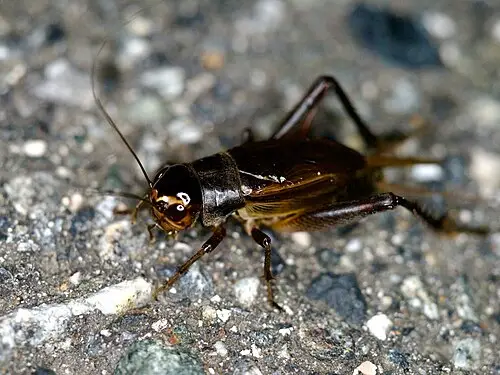
 📸 Photo
Photo: りなべる (re_nebel) · CC BY 4.0 · Wikimedia Commons Source
Emma field cricket
Teleogryllus emma (Emma field cricket · エンマコオロギ)
Not Evaluated (NE) on the IUCN Red List yet.
💡 Everyday Comparisons for Size, Mass & Speed
- 💡 Its maximum body length of 31 mm is about 1.3 times the diameter of a Korean 100-won coin (24 mm) (Comparison).
- 💡 Materials from Japan's Ministry of Land, Infrastructure, Transport and Tourism note that it produces a clear, rolling chirp in grasslands and fields and is preyed upon by hunting wasps and mantises.
- 💡 Studies show that adults grow smaller in colder regions, meaning even within the same cricket species, body size varies with local temperature.
Reference standards: coach bus ~12 m, mid-size car ~4.9 m, compact car ~1 t, basketball hoop 3.05 m, credit card 8.56 cm.
📖 1. Overview
The Emma field cricket is a large cricket living in grasslands and fields, widely distributed across the Japanese archipelago and also recorded in Korea. It has 1 generation per year and overwinters as an egg.
🦴 2. Anatomy & Morphology
Adult body length is 17–31 mm; the body is mostly blackish-brown with a faint brownish-white eyebrow marking behind the eyes. The female's ovipositor is 20.5–21 mm long, and the face is rounded without projecting forward.
🔍 3. Ecology & Behavior
It is omnivorous and eats almost anything, but mainly prefers animal matter. Eggs laid underground by females overwinter and hatch around June of the following year, and nymphs become adults from early August to early September.
🇰🇷 4. Connection to Korea
It is listed as 'Wang-gwitturami' (Korean name) in the National List of Species of Korea by the National Institute of Biological Resources (NIBR).
📚 Sources & References
- • IUCN Red List: not evaluated (NE) — cross-checked with the Wikidata conservation-status entry
- • catalogueoflife.org — 555XF
- • 국가생물종목록(국립생물자원관) ktsn 120000037646 — https://species.nibr.go.kr/home/mainHome.do?cont_link=009&subMenu=009002&contCd=009002&ktsn=120000037646
- • wikidata.org — Q5353744
- • commons.wikimedia.org — File:Teleogryllus emma from iNaturalist photo 570943835.jpg
- • cgr.mlit.go.jp — index156.htm
- • jor.pensoft.net — xml
- • Silhouette: PhyloPic — Didier Descouens · CC BY 4.0 (Related taxon silhouette — Gryllus campestris)
Recorded dimensions are widely cited representative estimates from public literature and may vary by study or specimen.