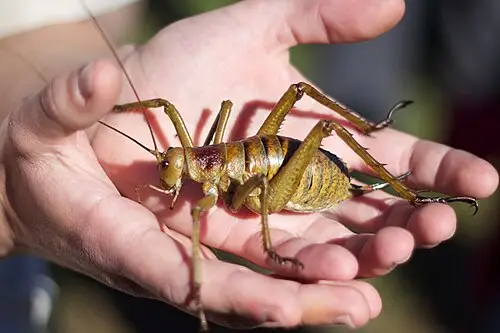
 📸 Photo
Photo: Dinobass · CC BY-SA 4.0 · Wikimedia Commons Source
Wetapunga
Deinacrida heteracantha (Wetapunga · Wetapunga)
💡 Everyday Comparisons for Size, Mass & Speed
- 💡 The criterion that an adult front foot print exceeds 4.3 mm is about one-sixth the diameter of a Korean 500-won coin (26.5 mm) (Comparison).
- 💡 When 4 g (about ½ teaspoon) of peanut butter was placed as bait in rat-monitoring footprint tracking tunnels, the detection rate for adult wetapunga was 55%, higher than the 12% in unbaited tunnels (New Zealand Journal of Ecology).
Reference standards: coach bus ~12 m, mid-size car ~4.9 m, compact car ~1 t, basketball hoop 3.05 m, credit card 8.56 cm.
📖 1. Overview
The wetapunga (giant weta) is New Zealand's largest terrestrial invertebrate. It once lived widely across Auckland, Northland, Waiheke Island, and Great Barrier Island, but as of a 2008 paper it survives only on rat-free Little Barrier Island.
🦴 2. Anatomy & Morphology
Adults are 9th–10th instars, and subadults are 5th–8th instar nymphs. Adults can be identified by their tracks: if the front, middle, and hind tarsal prints exceed 4.3 mm, 4.9 mm, and 8.9 mm respectively, they belong to an adult wetapunga.
🔍 3. Ecology & Behavior
During the day it rests among epiphytes, in tree hollows, or under loose bark, and at night it mainly eats fresh leaves. Since Polynesian rats (kiore) were eradicated, its numbers are said to be slowly increasing. Because giant wetas resemble small mammals in biomass, nocturnal habits, and omnivory, they are sometimes called 'invertebrate mice.'
🇰🇷 4. Connection to Korea
No direct record connecting this species to Korea has been found.
📚 Sources & References
- • IUCN Red List VU (1996) — https://www.iucnredlist.org/species/6305/12602299
- • IUCN Red List category VU — latest assessment at iucnredlist.org
- • catalogueoflife.org — 6CGG4
- • iucnredlist.org — 12602299
- • wikidata.org — Q308158
- • commons.wikimedia.org — File:Wetapunga.jpg
- • newzealandecology.org — 2854.pdf
- • newzealandecology.org — 2854
- • Silhouette: PhyloPic — Melissa Broussard · CC BY 3.0 (Congeneric silhouette — Deinacrida rugosa)
Recorded dimensions are widely cited representative estimates from public literature and may vary by study or specimen.