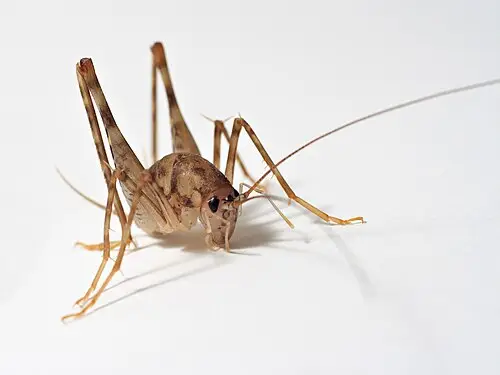
 📸 Photo
Photo: Thegreenj · CC BY-SA 3.0 · Wikimedia Commons Source
Tachycines coreanus
Tachycines coreanus (Tachycines coreanus · クラズミウマ)
Not Evaluated (NE) on the IUCN Red List yet.
💡 Everyday Comparisons for Size, Mass & Speed
- 💡 A body length of 2 cm is about 3/4 the diameter of a Korean 500-won coin (2.65 cm) (Comparison).
- 💡 It comes out at night in dark places such as flowerbeds around houses, warehouses, and basements, and adults can be seen from May to November (National List of Species of Korea).
Reference standards: coach bus ~12 m, mid-size car ~4.9 m, compact car ~1 t, basketball hoop 3.05 m, credit card 8.56 cm.
📖 1. Overview
Tachycines coreanus is an insect with a hunchback-like curved back that hides in dark places around houses, warehouses, basements, low hills, and caves and is active at night. It is distributed throughout Korea and extends to Nagasaki in Japan, Ningbo in China, and the Russian Far East.
🦴 2. Anatomy & Morphology
Its body length is 13–20 mm, and it is a glossy light brown. There are black stripes along the rear margin of the pronotum and the dorsal side of the abdominal segments, with no spotted markings on the body or legs. Spines on the upper side of the hind tibiae are arranged at intervals in groups of 2–4.
🔍 3. Ecology & Behavior
It hides in dark places and is active at night, and females lay eggs in soil or flowerbeds around their habitat. Adults appear from May to November.
🇰🇷 4. Connection to Korea
It is distributed throughout Korea and also lives around houses, warehouses, and basements (National List of Species of Korea).
📚 Sources & References
- • IUCN Red List: not evaluated (NE) — cross-checked with the Wikidata conservation-status entry
- • catalogueoflife.org — CHJ8K
- • 국가생물종목록(국립생물자원관) ktsn 120000129051 — https://species.nibr.go.kr/home/mainHome.do?cont_link=009&subMenu=009002&contCd=009002&ktsn=120000129051
- • wikidata.org — Q15846426
- • commons.wikimedia.org — File:Ceuthophiluscricket.jpg
- • species.nibr.go.kr — mainHome.do
- • Silhouette: PhyloPic — TGHays · CC BY 4.0 (Related taxon silhouette — Pristoceuthophilus pacificus)
Recorded dimensions are widely cited representative estimates from public literature and may vary by study or specimen.