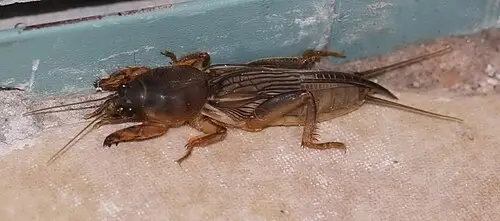
 📸 Photo
Photo: 辻畠 · CC BY-SA 4.0 · Wikimedia Commons Source
Oriental mole cricket
Gryllotalpa orientalis (Oriental mole cricket · ケラ)
Not Evaluated (NE) on the IUCN Red List yet.
💡 Everyday Comparisons for Size, Mass & Speed
- 💡 Its body length of 3 cm is slightly longer than the diameter of a Korean 500-won coin (2.65 cm) (Comparison).
- 💡 The sound once thought to be earthworms crying underground on rainy days is actually the calling of the oriental mole cricket (National List of Species of Korea).
Reference standards: coach bus ~12 m, mid-size car ~4.9 m, compact car ~1 t, basketball hoop 3.05 m, credit card 8.56 cm.
📖 1. Overview
The oriental mole cricket is an insect with shovel-like forelegs adapted for digging underground, distributed throughout the Korean Peninsula (including Ulleungdo and Jeju Island) as well as across Asia and Europe.
🦴 2. Anatomy & Morphology
Its body is about 30 mm long, brown or dark brown, and covered in fine hairs. Its antennae are short, its forelegs are shovel-shaped with hearing organs on the foreleg tibiae, and two long cerci extend from the tip of the body.
🔍 3. Ecology & Behavior
It feeds underground on plant stems and roots, earthworms, and insects. Females lay about 300 eggs underground from May to July, which hatch in 16–36 days; it has 1 generation a year and overwinters as an adult. Males call with a 'bii—' sound from burrow entrances.
🇰🇷 4. Connection to Korea
It inhabits the entire Korean Peninsula (including Ulleungdo and Jeju Island) and can become an agricultural pest by tunneling through lawns and farmland and damaging crop roots (National List of Species of Korea).
📚 Sources & References
- • IUCN Red List: not evaluated (NE) — cross-checked with the Wikidata conservation-status entry
- • catalogueoflife.org — 6L5NS
- • 국가생물종목록(국립생물자원관) ktsn 120000037663 — https://species.nibr.go.kr/home/mainHome.do?cont_link=009&subMenu=009002&contCd=009002&ktsn=120000037663
- • wikidata.org — Q4154229
- • commons.wikimedia.org — File:Mole cricket03.jpg
- • species.nibr.go.kr — mainHome.do
- • Silhouette: PhyloPic — Didier Descouens · CC BY 4.0 (Congeneric silhouette — Gryllotalpa gryllotalpa)
Recorded dimensions are widely cited representative estimates from public literature and may vary by study or specimen.