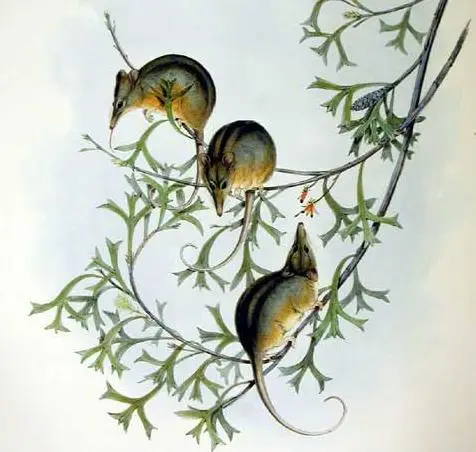
 📸 Photo
Photo: John Gould · Public domain · Wikimedia Commons Source
Honey Possum
Tarsipes rostratus (Honey Possum · フクロミツスイ)
💡 Everyday Comparisons for Size, Mass & Speed
- 💡 Its maximum weight of 18 g is slightly heavier than two Korean 500-won coins (about 15.4 g), and its maximum body length of 9 cm is about 2/3 of a ballpoint pen (about 14 cm) (Comparison).
- 💡 Males have the largest sperm of any mammal, and their testes are very large relative to their body size, accounting for over 4% of their body weight.
Reference standards: coach bus ~12 m, mid-size car ~4.9 m, compact car ~1 t, basketball hoop 3.05 m, credit card 8.56 cm.
Site-computed relative index from recorded values; not a formal scientific metric.
📖 1. Overview
The Honey Possum is a tiny marsupial living in banksia woodlands of southwestern Australia that feeds exclusively on pollen and nectar.
🦴 2. Anatomy & Morphology
It has gray fur with a brown back and a dark stripe running from the nape to the base of the tail. Its head is flat with a long snout, and it can extend a brush-tipped tongue as long as its head. Its cheek teeth are greatly reduced.
🔍 3. Ecology & Behavior
It eats pollen and nectar from various flowering plants and is the only flightless animal that feeds solely on pollen and nectar. Active at night or dusk, females mate with multiple males and give birth to litters of 2–3 young (up to 4).
🇰🇷 4. Connection to Korea
No direct record connecting this species to Korea has been found.
📚 Sources & References
- • IUCN Red List LC (2016) — https://www.iucnredlist.org/species/40583/21958924
- • IUCN Red List category LC — latest assessment at iucnredlist.org
- • mammaldiversity.org — 1000368
- • iucnredlist.org — 21958924
- • wikidata.org — Q752020
- • commons.wikimedia.org — File:Tarsipes rostratus - Gould.jpg
- • animaldiversity.org — Tarsipes rostratus
Recorded dimensions are widely cited representative estimates from public literature and may vary by study or specimen.