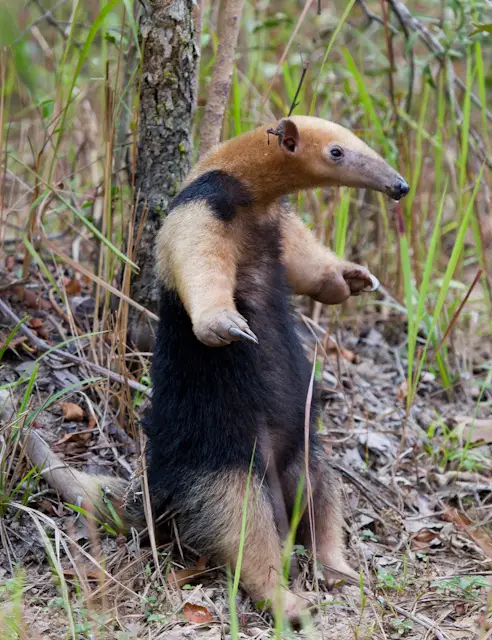
 📸 Photo
Photo: Sinara Conessa · CC BY 2.0 · Wikimedia Commons Source
Southern Tamandua
Tamandua tetradactyla (Southern Tamandua · ミナミコアリクイ)
💡 Everyday Comparisons for Size, Mass & Speed
- 💡 Its average weight of 4.5 kg equals three 1.5 L bottles of water, and its tongue of up to 40 cm is longer than a 30 cm ruler (Comparison).
- 💡 Indigenous Amazonian peoples have used it to clear ants and termites from their homes and made rope from its tail tendons.
- 💡 At the Smithsonian's National Zoo, it is raised on insects and an insectivore diet mash.
Reference standards: coach bus ~12 m, mid-size car ~4.9 m, compact car ~1 t, basketball hoop 3.05 m, credit card 8.56 cm.
Site-computed relative index from recorded values; not a formal scientific metric.
📖 1. Overview
The Southern Tamandua is a widespread South American anteater active both in trees and on the ground. Coat color varies by region, with some populations bearing a dark vest marking from shoulders to back.
🦴 2. Anatomy & Morphology
Its fur is short and dense, and the hairless underside of its tail grips branches securely. Toothless, it grinds food in a muscular gizzard-like stomach, and through a mouth opening only about 6 mm wide it can extend its tongue up to 40 cm.
🔍 3. Ecology & Behavior
Locating tree-dwelling ants and termites by scent, it rips open nests with its forelimbs and laps them up with its tongue, and also eats honey and bees. Mostly nocturnal and solitary, it rests in tree hollows by day and gives birth to a single young that rides on its mother's back.
🇰🇷 4. Connection to Korea
No direct record connecting this species to Korea has been found.
📚 Sources & References
- • IUCN Red List LC (2025) — https://www.iucnredlist.org/species/21350/210445394
- • IUCN Red List category LC — latest assessment at iucnredlist.org
- • mammaldiversity.org — 1000444
- • iucnredlist.org — 210445394
- • wikidata.org — Q267514
- • commons.wikimedia.org — File:T tetradactyla 1.jpg
- • animaldiversity.org — Tamandua tetradactyla
- • nationalzoo.si.edu — southern-tamandua
- • Silhouette: PhyloPic — Kai Caspar · CC0 1.0
Recorded dimensions are widely cited representative estimates from public literature and may vary by study or specimen.