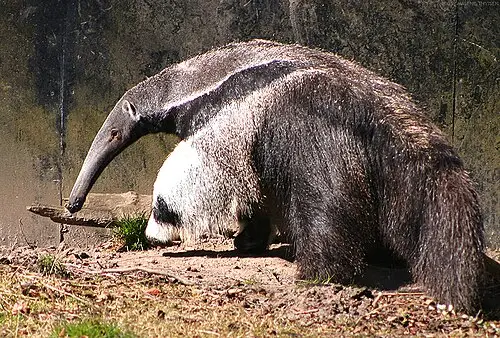
 📸 Photo
Photo: Malene Thyssen · CC BY-SA 3.0 · Wikimedia Commons Source
Giant Anteater
Myrmecophaga tridactyla (Giant Anteater · オオアリクイ)
💡 Everyday Comparisons for Size, Mass & Speed
- 💡 Extending its tongue up to 61 cm is about the length of two 30 cm rulers placed end to end (Comparison).
- 💡 A maximum weight of 39 kg is close to two 20 kg bags of rice (Comparison).
Reference standards: coach bus ~12 m, mid-size car ~4.9 m, compact car ~1 t, basketball hoop 3.05 m, credit card 8.56 cm.
Site-computed relative index from recorded values; not a formal scientific metric.
📖 1. Overview
The Giant Anteater is a toothless terrestrial mammal of Central and South America that eats ants and termites with its very long snout and tongue.
🦴 2. Anatomy & Morphology
Its snout reaches up to 45 cm in length, and its tongue can extend up to 61 cm. The three inner claws on its front feet are long and sharp.
🔍 3. Ecology & Behavior
It feeds on ants, termites, and soft larvae, flicking its tongue 150 times per minute to swallow thousands of insects in just a few minutes. Females usually give birth to a single young, which rides on the mother's back.
🇰🇷 4. Connection to Korea
No direct record connecting this species to Korea has been found.
📚 Sources & References
- • IUCN Red List VU (2025) — https://www.iucnredlist.org/species/14224/210444314
- • IUCN Red List category VU — latest assessment at iucnredlist.org
- • mammaldiversity.org — 1000442
- • iucnredlist.org — 210444314
- • wikidata.org — Q203033
- • commons.wikimedia.org — File:Myresluger2.jpg
- • animaldiversity.org — Myrmecophaga tridactyla
- • Silhouette: PhyloPic — Steven Traver · CC0 1.0
Recorded dimensions are widely cited representative estimates from public literature and may vary by study or specimen.