 📸 Photo
Photo: Esv - Eduard Solà Vázquez · CC BY-SA 3.0 · Wikimedia Commons Source
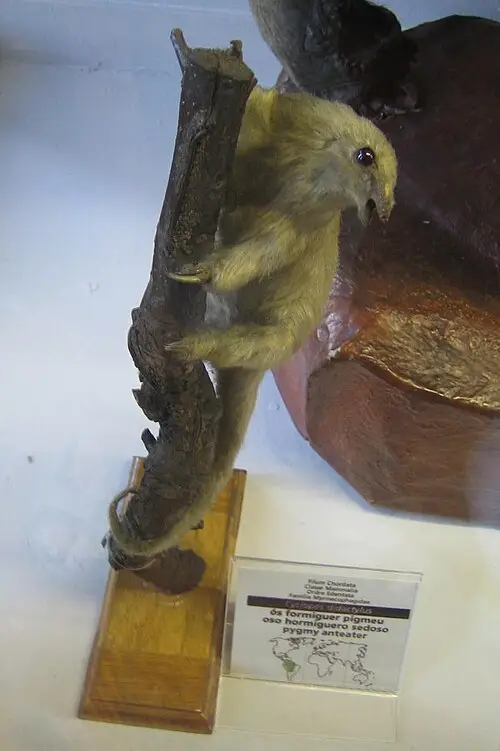
Common Silky Anteater
Cyclopes didactylus (Common Silky Anteater · ヒメアリクイ)
💡 Everyday Comparisons for Size, Mass & Speed
- 💡 Its average weight of 266 g equals the combined weight of 4–5 chicken eggs (Comparison).
- 💡 Eating up to 8,000 ants a day, it is a tiny hunter that helps regulate treetop insect numbers.
- 💡 Because sharp-eyed birds such as harpy eagles and owls are its predators, its silvery fur serves as camouflage.
Reference standards: coach bus ~12 m, mid-size car ~4.9 m, compact car ~1 t, basketball hoop 3.05 m, credit card 8.56 cm.
Site-computed relative index from recorded values; not a formal scientific metric.
📖 1. Overview
The Common Silky Anteater is the smallest of the anteaters, an arboreal animal active at night that almost never comes down to the ground. It is slow-moving and not aggressive.
🦴 2. Anatomy & Morphology
Its silky silvery fur looks almost identical to the silvery fibers inside Ceiba seed pods, making it hard to spot among the pods. When threatened, it stands on its hind legs, grips a branch with its hind feet and tail, and strikes quickly with its large front claws.
🔍 3. Ecology & Behavior
It feeds strictly on arboreal ants and termites, eating about 100–8,000 ants a day. After a gestation period of about 120–150 days, females give birth to a single young; both parents raise it on regurgitated semi-digested insects, and the male sometimes carries it on his back.
🇰🇷 4. Connection to Korea
No direct record connecting this species to Korea has been found.
📚 Sources & References
- • IUCN Red List LC (2025) — https://www.iucnredlist.org/species/199899729/199899746
- • IUCN Red List category LC — latest assessment at iucnredlist.org
- • mammaldiversity.org — 1000436
- • iucnredlist.org — 199899746
- • wikidata.org — Q244043
- • commons.wikimedia.org — File:Ós formiguer pigmeu.jpg
- • animaldiversity.org — Cyclopes didactylus
- • Silhouette: PhyloPic — author not recorded · Public Domain Mark 1.0
Recorded dimensions are widely cited representative estimates from public literature and may vary by study or specimen.