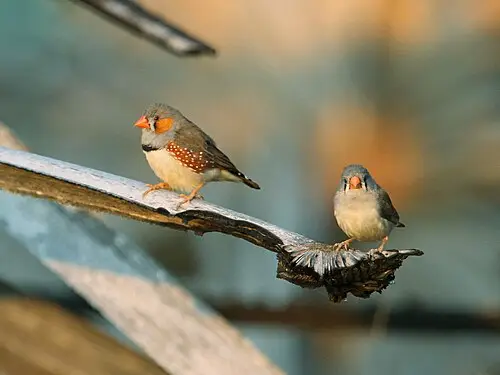
 📸 Photo
Photo: christoph_moning · CC BY 4.0 · Wikimedia Commons Source
Zebra Finch
Taeniopygia guttata (Zebra Finch · キンカチョウ)
💡 Everyday Comparisons for Size, Mass & Speed
- 💡 Its weight of 12 g is slightly heavier than one Korean 500-won coin (about 7.7 g) (Comparison).
- 💡 According to ADW, if tamed from a young age it becomes friendly enough to eat from a person's hand, so it is kept worldwide and also used as a model organism for studying pair bonding and song.
Reference standards: coach bus ~12 m, mid-size car ~4.9 m, compact car ~1 t, basketball hoop 3.05 m, credit card 8.56 cm.
Site-computed relative index from recorded values; not a formal scientific metric.
📖 1. Overview
The Zebra Finch is a small finch about 10–11 cm long and weighing around 12 g that lives in savannas and dry regions. It is also kept as a companion bird around the world.
🦴 2. Anatomy & Morphology
Males have a gray head and back, a barred tail and throat, orange cheek patches, chestnut-spotted flanks, and a red bill. Females are gray all over with an orange bill.
🔍 3. Ecology & Behavior
It feeds mainly on various seeds along with fruits, vegetables, and insects. It lives in flocks of about 100 birds, can breed at any time of year after sufficient rain, and pairs for life.
🇰🇷 4. Connection to Korea
No direct record connecting this species to Korea has been found.
📚 Sources & References
- • IUCN Red List LC (2018) — https://www.iucnredlist.org/species/103817982/132195948
- • IUCN Red List category LC — latest assessment at iucnredlist.org
- • doi.org — avilist.v2026
- • iucnredlist.org — 132195948
- • wikidata.org — Q331065
- • commons.wikimedia.org — File:2014-08-19 Zebra Finch, Sumba, Nusa Tenggara Timur, Ind
- • animaldiversity.org — Taeniopygia guttata
- • Silhouette: PhyloPic — Andy Wilson · CC0 1.0
Recorded dimensions are widely cited representative estimates from public literature and may vary by study or specimen.