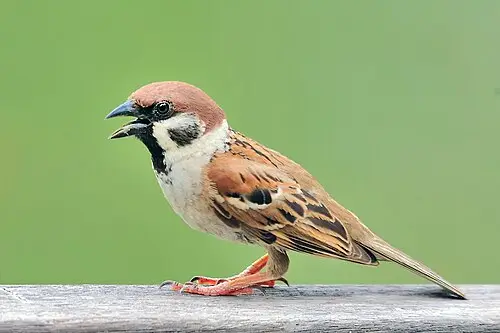
 📸 Photo
Photo: Yiwenyiwen · CC BY-SA 4.0 · Wikimedia Commons Source
Eurasian Tree Sparrow
Passer montanus (Eurasian Tree Sparrow · スズメ)
💡 Everyday Comparisons for Size, Mass & Speed
- 💡 When grain ripens, it pecks at rice crops and causes agricultural damage, and in the past people also roasted and ate it on Nabil (a traditional winter day) (Encyclopedia of Korean Culture).
- 💡 Its weight of 20–25 g is about three Korean 500-won coins (7.7 g) (Comparison).
Reference standards: coach bus ~12 m, mid-size car ~4.9 m, compact car ~1 t, basketball hoop 3.05 m, credit card 8.56 cm.
Site-computed relative index from recorded values; not a formal scientific metric.
📖 1. Overview
The Eurasian Tree Sparrow is a small bird living widely across Eurasia, and in Korea it is the most common resident bird breeding nationwide.
🦴 2. Anatomy & Morphology
Its head is purplish-brown, its face is white with a black spot on the cheek, and its wings have two thin white bars. Males and females have the same coloring.
🔍 3. Ecology & Behavior
It feeds mainly on grass seeds and also catches insects during the breeding season. It breeds under eaves, in building crevices, on utility poles, and in magpie nests, laying eggs up to 3 times in 1 year.
🇰🇷 4. Connection to Korea
It is the most common resident bird breeding nationwide.
📚 Sources & References
- • IUCN Red List LC (2025) — https://www.iucnredlist.org/species/22718270/137421099
- • IUCN Red List category LC — latest assessment at iucnredlist.org
- • doi.org — avilist.v2026
- • iucnredlist.org — 137421099
- • 국가생물종목록(국립생물자원관) ktsn 120000002157 — https://species.nibr.go.kr/home/mainHome.do?cont_link=009&subMenu=009002&contCd=009002&ktsn=120000002157
- • wikidata.org — Q25968
- • commons.wikimedia.org — File:Eurasian Tree Sparrow.jpg
- • audubon.org — eurasian-tree-sparrow
- • encykorea.aks.ac.kr — E0055275
- • avifauna.hkbws.org.hk — 052700
- • Silhouette: PhyloPic — Laitche · Public Domain Mark 1.0
Recorded dimensions are widely cited representative estimates from public literature and may vary by study or specimen.