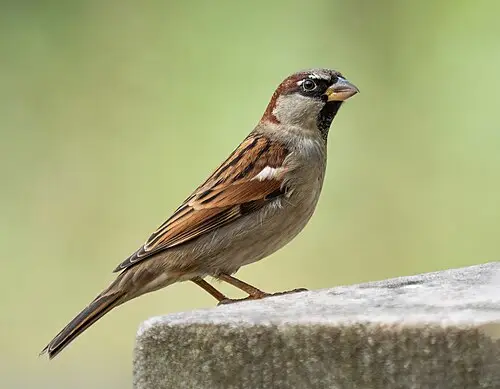
 📸 Photo
Photo: Rhododendrites · CC BY-SA 4.0 · Wikimedia Commons Source
House Sparrow
Passer domesticus (House Sparrow · イエスズメ)
💡 Everyday Comparisons for Size, Mass & Speed
- 💡 Its average weight of 28.5 g is slightly heavier than an AA battery (about 23 g) (Comparison).
- 💡 According to ADW, it nests in building crevices and eats birdseed in farms, residential areas, and cities, and is considered well suited for studying how animals evolve and pest control.
Reference standards: coach bus ~12 m, mid-size car ~4.9 m, compact car ~1 t, basketball hoop 3.05 m, credit card 8.56 cm.
Site-computed relative index from recorded values; not a formal scientific metric.
📖 1. Overview
The House Sparrow is a stocky sparrow living in human-modified places such as farms, residential areas, and cities. It is absent from uninhabited places such as forests or deserts.
🦴 2. Anatomy & Morphology
Both sexes have a brown back with black streaks and pale buff underparts. Males have white cheeks and a black bib, which females lack.
🔍 3. Ecology & Behavior
It hops on the ground eating seeds and some insects. It builds nests in building crevices or trees using dried grass, feathers, string, and paper, laying 1–8 eggs per clutch and up to four clutches a season.
🇰🇷 4. Connection to Korea
No direct record connecting this species to Korea has been found.
📚 Sources & References
- • IUCN Red List LC (2019) — https://www.iucnredlist.org/species/103818789/155522130
- • IUCN Red List category LC — latest assessment at iucnredlist.org
- • doi.org — avilist.v2026
- • iucnredlist.org — 155522130
- • 국가생물종목록(국립생물자원관) ktsn 120000002155 — https://species.nibr.go.kr/home/mainHome.do?cont_link=009&subMenu=009002&contCd=009002&ktsn=120000002155
- • wikidata.org — Q14683
- • commons.wikimedia.org — File:House sparrow male in Prospect Park (53532).jpg
- • animaldiversity.org — Passer domesticus
- • Silhouette: PhyloPic — Andy Wilson · CC0 1.0
Recorded dimensions are widely cited representative estimates from public literature and may vary by study or specimen.