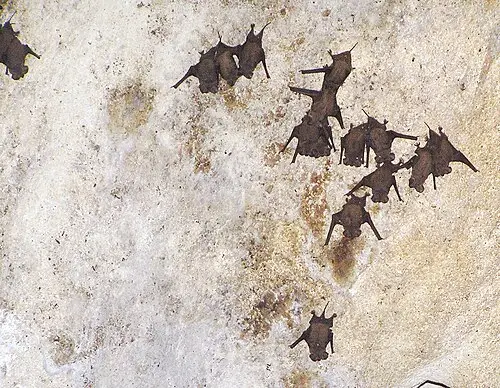
 📸 Photo
Photo: Matti Mero · Public domain · Wikimedia Commons Source
Brazilian Free-tailed Bat
Tadarida brasiliensis (Brazilian Free-tailed Bat · メキシコオヒキコウモリ)
💡 Everyday Comparisons for Size, Mass & Speed
- 💡 Eating vast numbers of insects every night, it reduces crop pests and disease-carrying insects, and its guano has been used as fertilizer and a gunpowder ingredient.
- 💡 It also roosts in human-made structures such as under bridges and in attics.
- 💡 Its maximum weight of 12 g is about one and a half Korean 500-won coins (about 7.7 g each) (Comparison).
Reference standards: coach bus ~12 m, mid-size car ~4.9 m, compact car ~1 t, basketball hoop 3.05 m, credit card 8.56 cm.
Site-computed relative index from recorded values; not a formal scientific metric.
📖 1. Overview
The Brazilian Free-tailed Bat is an insect-eating bat that forms huge colonies in caves or under bridges and flies fast and straight over long distances.
🦴 2. Anatomy & Morphology
It has brown fur, large ears, a short snout, and wrinkled upper lips, with the tip of its tail extending well beyond the tail membrane. Its long, narrow, pointed wings are suited for rapid, direct flight.
🔍 3. Ecology & Behavior
After sunset it hunts all night, flying more than 50 km to foraging grounds and reaching altitudes over 3,300 m, the highest recorded among bats. It catches moths, beetles, dragonflies, flies, true bugs, and wasps on the wing.
🇰🇷 4. Connection to Korea
No direct record connecting this species to Korea has been found.
📚 Sources & References
- • IUCN Red List LC (2015) — https://www.iucnredlist.org/species/21314/22121621
- • IUCN Red List category LC — latest assessment at iucnredlist.org
- • mammaldiversity.org — 1005262
- • iucnredlist.org — 22121621
- • wikidata.org — Q913930
- • commons.wikimedia.org — File:Tadarida brasiliensis - Bahamas - Long Island (sic) - C
- • animaldiversity.org — Tadarida brasiliensis
Recorded dimensions are widely cited representative estimates from public literature and may vary by study or specimen.