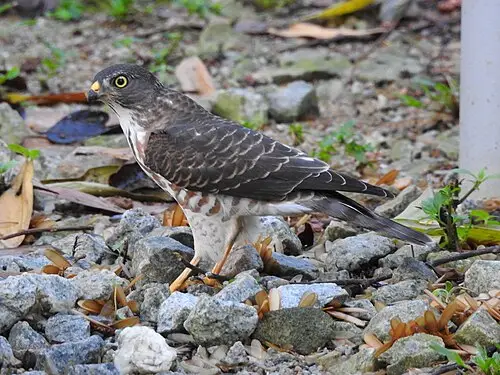
 📸 Photo
Photo: (c) anukma, some rights reserved (CC BY) · CC BY 4.0 · Wikimedia Commons Source
Chinese Sparrowhawk
Tachyspiza soloensis (Chinese Sparrowhawk · Chinese Sparrowhawk)
Not Evaluated (NE) on the IUCN Red List yet.
🇰🇷 Class II endangered wildlife (Korea) · Natural Monument (Korea) «Chinese Sparrowhawk»
💡 Everyday Comparisons for Size, Mass & Speed
- 💡 Its maximum body length of 35 cm is slightly longer than the long side of an A4 sheet of paper (29.7 cm) (Comparison).
- 💡 Because it feeds on frogs in rice paddies and wetlands, declines in frog numbers caused by pesticides directly affect its population.
- 💡 Two individuals fitted with GPS trackers in southern China flew more than 4,000–5,000 km during their autumn and spring migrations.
Reference standards: coach bus ~12 m, mid-size car ~4.9 m, compact car ~1 t, basketball hoop 3.05 m, credit card 8.56 cm.
📖 1. Overview
The Chinese Sparrowhawk is a small bird of prey that breeds in southern China and on the Korean Peninsula and winters in Southeast Asia. Its former scientific name is Accipiter soloensis.
🦴 2. Anatomy & Morphology
Its upperparts are bluish-gray, its breast is pale orange, and its lower belly is white.
🔍 3. Ecology & Behavior
It feeds mainly on frogs, also catches small birds and insects, and feeds frogs to its chicks. On the Korean Peninsula, it is a summer visitor arriving in early May and departing in September.
🇰🇷 4. Connection to Korea
In Korea, it is a Class II endangered wildlife (Korea) and was designated as a Natural Monument (Korea) on November 16, 1982. Its population is reported to have declined sharply as its frog prey became contaminated by agricultural pesticides.
📚 Sources & References
- • 멸종위기 야생생물 Ⅱ급 · 천연기념물 «붉은배새매» — 국가생물종목록(국립생물자원관) ktsn 120000001602 — https://species.nibr.go.kr/home/mainHome.do?cont_link=009&subMenu=009002&contCd=009002&ktsn=120000001602
- • IUCN Red List: not evaluated (NE) — cross-checked with the Wikidata conservation-status entry
- • Korean protection status: Class II endangered wildlife (Korea) · Natural Monument (Korea) «Chinese Sparrowhawk»
- • doi.org — avilist.v2026
- • 국가생물종목록(국립생물자원관) ktsn 120000001602 — https://species.nibr.go.kr/home/mainHome.do?cont_link=009&subMenu=009002&contCd=009002&ktsn=120000001602
- • heritage.go.kr — culSelectDetail.do
- • commons.wikimedia.org — File:Chinese Sparrowhawk imported from iNaturalist photo 527
- • nie.re.kr — view.do
- • pmc.ncbi.nlm.nih.gov — PMC8388367
- • avifauna.hkbws.org.hk — 025300
- • Silhouette: PhyloPic — Robert Cooke · CC0 1.0 (Related taxon silhouette — Accipitridae)
Recorded dimensions are widely cited representative estimates from public literature and may vary by study or specimen.