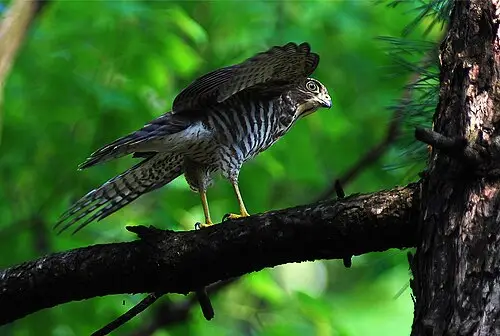
 📸 Photo
Photo: たー坊 · CC BY-SA 3.0 · Wikimedia Commons Source
Japanese Sparrowhawk
Tachyspiza gularis (Japanese Sparrowhawk · Japanese Sparrowhawk)
Not Evaluated (NE) on the IUCN Red List yet.
🇰🇷 Class II endangered wildlife (Korea)
💡 Everyday Comparisons for Size, Mass & Speed
- 💡 In Japan, it began breeding in residential neighborhoods starting in the 1980s.
- 💡 Its weight of 0.193 kg is just over the weight of 3 chicken eggs (taking 1 egg as 60 g, Comparison).
- 💡 Raising a brood of chicks is said to require about 350 small birds.
Reference standards: coach bus ~12 m, mid-size car ~4.9 m, compact car ~1 t, basketball hoop 3.05 m, credit card 8.56 cm.
Site-computed relative index from recorded values; not a formal scientific metric.
📖 1. Overview
The Japanese Sparrowhawk is a tiny sparrowhawk living in East Asia that swiftly catches small birds in broadleaf forests, parks, and farmlands. Its former scientific name is Accipiter gularis.
🦴 2. Anatomy & Morphology
The sexes differ markedly in size, with females being larger. Males have bluish-gray upperparts and red eyes, whereas females have dark gray upperparts and yellow eyes.
🔍 3. Ecology & Behavior
It eats small mammals, insects, and bats, and catches birds such as sparrows, tits, pigeons, and swallows in flight. It builds its nest high in tall trees, laying 2–5 eggs and incubating them for about 29 days.
🇰🇷 4. Connection to Korea
In Korea, it is a Class II endangered wildlife (Korea).
📚 Sources & References
- • 멸종위기 야생생물 Ⅱ급 — 국가생물종목록(국립생물자원관) ktsn 120000001603 — https://species.nibr.go.kr/home/mainHome.do?cont_link=009&subMenu=009002&contCd=009002&ktsn=120000001603
- • IUCN Red List: not evaluated (NE) — cross-checked with the Wikidata conservation-status entry
- • Korean protection status: Class II endangered wildlife (Korea)
- • doi.org — avilist.v2026
- • 국가생물종목록(국립생물자원관) ktsn 120000001603 — https://species.nibr.go.kr/home/mainHome.do?cont_link=009&subMenu=009002&contCd=009002&ktsn=120000001603
- • commons.wikimedia.org — File:20100710 tumi nagoya 03.jpg
- • peregrinefund.org — japanese-sparrowhawk-0
- • nie.re.kr — enspc06003v.do
- • Silhouette: PhyloPic — Robert Cooke · CC0 1.0 (Related taxon silhouette — Accipitridae)
Recorded dimensions are widely cited representative estimates from public literature and may vary by study or specimen.